Category Archives: Birds and Butterflies

Birds and butterflies of the Arboretum

Wintry Weather

I don’t know about you, but I like cold and snow; I always have. I even  like shoveling snow. I guess there’s something about bundling up in layers to keep warm – a “me vs. the cold” sort of thing – and all the other things I did keep the cold at bay. I still remember the snow pants that I had as a child, the ones with the elastic band that went under my foot to keep the pants tucked into my boots. And wearing so many other layers that my arms couldn’t move easily. I also remember as a child sitting outside in the fall, making a nest out of blankets and such, trying my best to see if I could stay warm. My grandma’s house was always very cold upstairs in the winter, and we all just piled on the blankets to stay toasty.  Many a night I woke up in the same position I went to sleep in because the weight of the blankets kept me from moving! All of us would fight to stand on the heating vent in the kitchen once we came in from the cold. And my cats have been know to lay (or should that be lie – I never can remember!) directly on our heating vents. I’m not sure how they manage, as placing my hand on the metal for more than a few seconds is uncomfortable.

Other creatures in our neighborhood are doing things to keep warm. The squirrels are bushy with extra fur. The birds (cardinals, Carolina wrens) that come to our back yard will sun themselves or fluff up their feathers. Yesterday, I saw a red-tailed hawk in the tree across from our house. He seemed to be all fluffy to keep warm. By the way, Pete was very happy to hear that I saw that particular hawk; it seems they don’t always hang about near homes, unlike the Cooper’s hawk that is a more frequent visitor to urban areas. The woodpeckers and nuthatches that come into our yard must keep warm by hopping about on the trees. It still amazes me how they can do that without falling off.

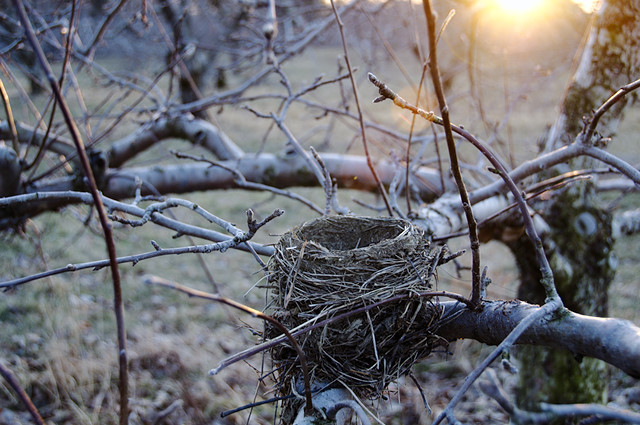
Speaking of birds, Pete and I went for a walk on Thursday as the snow was falling. We went down through Wahalla Ravine, one of our favorite places to walk. The little stream that travels along the road is so musical to hear, and the snow covering the shale on its banks is lovely. I had wanted to take my phone to take pictures, but the snow was falling hard enough that I worried about it getting too wet. Anyhow, on our walk we went by a smaller tree planted in the tree lawn, about six or seven feet tall. It didn’t have too many branches, but yet, near the top, was a bird’s nest. Pete remarked that it takes so little to make the birds happy, that even the smaller trees can immediately make a difference in their habitat. Every little thing makes a difference, so image what all of the trees we planted in the Arboretum will do this year.
Until next time!
Your Morning Cup of Joe and Our Fine Feathered Friends

Americans love their coffee. In fact, 45% of all coffee grown ends up being consumed by Americans. Strangely enough, though, we aren’t the highest consumer of coffee; that honor goes to Denmark, which drinks about three times more per person than the United States. That translates into 12 kilograms of coffee, or (if I’ve managed the calculation right!) slightly more than 26 pounds of coffee. Americans drink about nine pounds, making us about 27th in the world for coffee consumption. Based on how much coffee my husband drinks, that sounds about right!

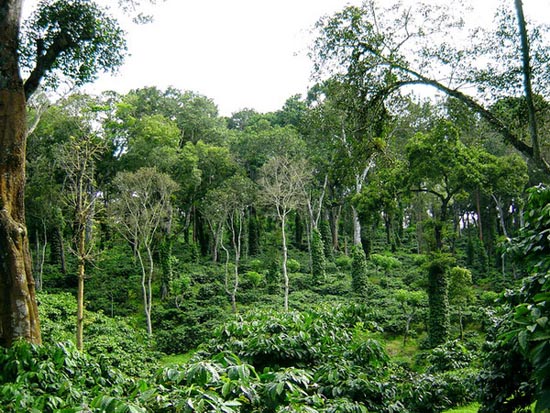
I imagine right about now, you are wondering just what all these interesting facts about coffee have to do with birds. Well, coffee actually has to do a lot with birds, especially seasonal migrants. When coffee was first discovered in the tropical forests of Africa, it was a  shade-loving plant, growing under large canopy trees. Subsequently, coffee spread to other tropical forested areas of the world, including our hemisphere. These forests provide migratory and resident birds a wonderful place to live. The trees, as we all know, also help the soil to remain healthy, control watersheds, and  preserve biodiversity. But as the popularity of coffee grew, new sun-loving coffee plants were developed that had an increased yield. However, the sun-grown coffee plants had some negative effects on the environment. These plants require full sun, so the canopy trees were cut down to create growing fields. The plants also need chemical fertilizers and pesticides that combine with rain runoff to endanger humans and wildlife. And finally, these sun-grown coffee plantations have about 90% less bird species in them compared to shade-grown coffee plantations. In the two pictures, you can really see the difference in how shade-grown and sun-grown coffee are being produced.

So, that cup of coffee you drink has a big impact on the birds in our neighborhood; so many of the birds we see in our ravines over-winter or migrate through shade-grown coffee plantations in Latin America. Here’s a list of  these birds that have been sighted in Glen Echo Ravine (and the list below constitutes 52% of all such migratory birds, so it’s quite a lot):

  • Sharp-shinned Hawk
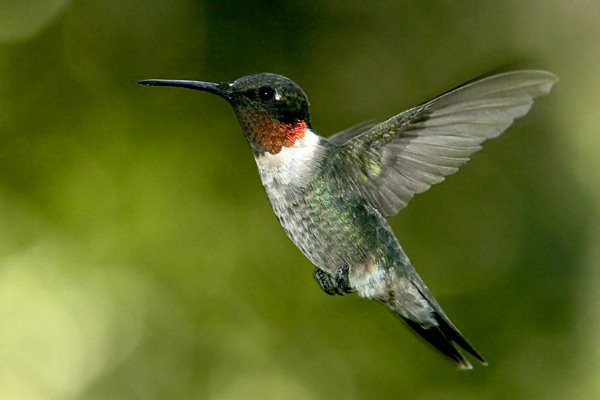
  • Ruby-throated Hummingbird
  • Yellow-bellied Flycatcher
  • Traill’s (Willow and Alder) Flycatcher
  • Least Flycatcher
  • Warbling Vireo
  • Red-eyed Vireo
  • Blue-gray Gnatcatcher
  • Swainson’s Thrush
  • Wood Thrush
  • Tennessee Warbler
  • Nashville Warbler
  • Yellow Warbler
  • Magnolia Warbler
  • Black-throated Green Warbler
  • Blackburnian Warbler
  • Black-and-white Warbler
  • American Redstart
  • Ovenbird
  • Kentucky Warblers
  • Hooded Warbler
  • Rose-breasted Grosbeak
  • Indigo Bunting
  • Baltimore Oriole

So what can you do to help? Spread the word and simply buy certified shade-grown coffee (or certified organic which is also shade-grown). It is available in many stores around Columbus as well as on-line. Some stores that Pete and I shop at that have shade-grown/organic coffee are the Clintonville Community Market, Giant Eagle, Global Gallery and Starbucks. I’m sure there are other stores as well that we just don’t know about; please let us know of any to add to our list.

And finally, shade-grown coffees will also likely be fair-trade, which helps promote healthier working conditions and greater economic incentives for the growers. And some of the stores have coffee that is even carbon neutral. Even better! Buying these kinds of coffees not only benefit our feathered friends, but all of those who depend on the rain forest as a place to live and work. So it’s a win-win situation for everyone.

Until next time.

Feeding Our Fine-Feathered Friends

It’s hard to believe with the temperatures outside in the 60s that very soon, winter will be here, and our little bird friends who are overwintering in Ohio would appreciate some assistance to get by. Today, in our backyard, we had several juncos, a pair of cardinals, and a Carolina wren feeding away in the leaf litter under our spice bushes. I’ve compiled a list of some of the birds that will be staying in Ohio and what we can do to give them a hand to make it through until spring arrives.

Woodpeckers (Pileated, red-bellied and downy): The pileated and downy woodpeckers love suet while the red-bellied loves sunflower seed, peanuts or corn.

Bluejays and juncos: These birds love sunflower seeds.

Chickadees, nuthatches, and tufted titmice: These little guys love suet and sunflower seeds.

Cardinals: Sunflower seeds

So, to attract birds, black oil sunflower seeds and suet seem to be the most popular forms of feed. Others include peanuts, corn, thistle, even fruit. Another important item is water, which can be hard to come by once the temperatures drop. A heater in your birdbath will solve that problem.

It’s also important to provide different types of feeders – platforms, hoppers, etc. I don’t know if birds begin to recognize my voice, but they always seem to appear when I called, “Bird bird bird!” as I fill the various feeders.

Until next time!

Stop, Children, What’s That Sound?

With the weather getting cooler in the mornings (Yea, no air conditioner running!), I’ve been able to walk to work again. Because of the Calumet bridge being closed, I’ve only got two routes to walk to OSU: High Street or Neil Avenue. Regardless of how I get to work, I take Olentangy Street along the ravine. A month ago, as I walked along Olentangy about a block east of High, I heard a bird song that I’ve never heard before. It’s a two-note call linked together, ending on the high note. I know it’s not a cardinal because it doesn’t sound the same. In fact, the call sounds like it wasn’t made by a bird at all but by a computer. It’s very hard to describe!

Well, I heard that bird again this week, this time a few houses from my home on Crestview. I spent a few futile minutes looking for the bird with no luck. Pete has no idea what the critter might be – mostly because I can’t reproduce the song very well, and he’s not heard it yet. So if anyone has any thoughts, please let me know!

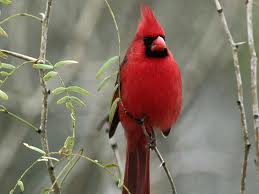
Speaking of cardinals, I read some interesting research on those birds. I love my finches, chickadees and cardinals. We have a pair of cardinals in our yard. Such beautiful birds, and so well-known. Anyway, the research is co-authored by Professor Amanda D. Rodewald of Ohio State. She indicates that cardinals in urban forests don’t lose their bright red color as easily as their rural counterparts. Color is important because females look for brighter colored males who are seen as being more healthy. But in urban areas, it’s argued that the carotenoid-rich foods that give the cardinal its scarlet color are more readily available, even to birds that aren’t in the best of shape. I just know that I love to see cardinals. That pop of color is wonderful! I especially like seeing them against the snow in winter. Pete tells me that cardinals are resident birds that stay all year long, unlike migratory birds that are only passing through on their way to somewhere else; think Canada Geese.

If you’ve any thoughts on my mysterious bird, send me a comment.

Until next time!

Ravine Clean-up Update and Other Things

I just wanted to let everyone know how the ravine clean-up last Saturday went. I could only stay for about an hour as my allergies would get the best of me had I stayed longer. As it was, I was very stuffy all of Sunday!

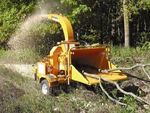
Anyway, the day went better than expected as far as the amount of invasives that were removed.I wasn’t surprised on the number of people who showed up to volunteer. A big thanks to everyone who turned out: members of Friends of the Ravine, Lower Olentangy Urban Arboretum, interested neighbors, Boy Scouts, too many groups to name them all. And a really big shout out to Carl and Tyrone from the City of Columbus. They brought a huge chipper and a chainsaw that made short work of all of the honeysuckle. Carl then went back to paint all the stumps with herbicide so they wouldn’t grow back. Pete took me to see the part of the work that was done at the western edge of the ravine by the Xenos School. Unbelievable. What had once been a forest of invasive honeysuckle was now clear, the way it was meant to be. The squirrels were wondering around, looking as if they didn’t recognize their home anymore. I don’t blame them – the change was nothing short of miraculous!

It was finally nice enough today for me to walk to work again, although I doubt I’ll be able to do so for the rest of the week. As I walked, I found a beautiful cardinal feather, such a vibrant red. It seems odd to me that with all the birds flying about, there wouldn’t be more feathers! I did miss walking through the Oval and the trees, but my walking route doesn’t take me that far.

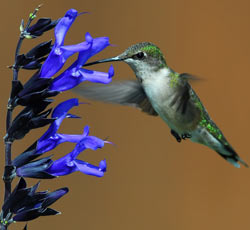
When I came home, Pete had planted our Swamp Oak in the backyard. We’ll be certain to keep it well watered this week with the high temperatures. It’s such a lovely tree, with its bi-colored leaves. The undersides are a beautiful silver color and the tops are a dark, verdant green. As we stood admiring it, a female hummingbird came to sit on the clothesline, just a few feet from where we were standing. I’ve named her Hannah. The funniest thing to hear is the squeaking noise she makes as she moves around. Hannah is very inquisitive and very territorial. Should another hummingbird enter her territory, she’s off in a blur to chase it away. I guess she doesn’t want anyone else sipping from the jewel weed, pineapple sage or other bright red flowers we have in the yard. Such a tiny little bundle of fierceness!

Until next time!

Baby Finch Update

We got good news on the baby finch today! I don’t know if you remember, but my friends Dan and Mike Came to my house, took a baby finch (still in its egg but poking his head out) up to the Ohio Wildlife Center. I hadn’t heard from the Center about the little guy (or girl) and feared the worse, that the little baby didn’t make it, even though when Mike and Dan left the Center, the little tyke was eating whatever it is that baby finches eat.

Well, today, the Center called to say that they had released my little baby finchnestling out into the big, wide world. I can’t tell you how happy that made me feel. After having three of the finch’s nests destroyed by who knows what and another hatchling that died, I was so sad for Mama and Papa Finch, who I still see in our yard. I thought that not one of their children would make it. So this news really made my day. Again, I can’t thank Mike and Dan enough for doing what they did. They saved that little guy.

Until next time!

Baby Finch Update

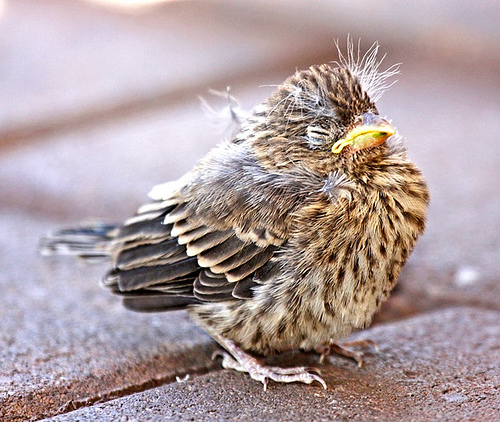
Well, it hasn’t gone very well for our nesting house finches. The second nest built by the first pair was also destroyed by a bird, perhaps a cowbird. The nest was moved and Mama Finch didn’t come back. There was one baby that had hatched and left all alone. Having no idea what to do with the little guy, I ended up doing nothing. I was afraid to feed him for fear of giving him something that would kill him. But I knew that if I didn’t feed him, he’d most likely die. I thought I could get him to the Ohio Wildlife Center if he made it through the night. Poor little lamb didn’t.

But there was another egg that had partially opened with the chick still inside; he was moving inside the egg, which was cracked and open. With the help of two special friends, Dan and Mike, the nest with its one remaining baby made it up to Ohio Wildlife Center. Last we heard, the little guy was taking nourishment. I am hopeful that he’s going to make it. They are pretty wonderful up at the center, taking in the baby rabbits and birds that we’ve found. It’s nice to know there is someplace to take injured and sick wildlife. And it’s also nice to know there are people out there who wouldn’t bat an eyelash at saving an unhatched egg – thanks just doesn’t seem to be enough.

The second pair’s nest was also destroyed with no sight of the eggs or babies. I know that these things happen in nature, but it is very sad to me; I feel like these finches are part of our family, a part that I want to protect.

Until next time.

Birds in our neighborhood

Today, I saw a mated pair of Cooper’s hawks flying above our house on Crestview. I think they have nested in the large oak tree down the street from us. We also have two pairs of finches (house finches, I think!) nesting in the ferns in hanging baskets on our porch. I call them Mama and Papa Finch. One nest has five light blue eggs in it; the other nest is just in the beginning stages of being built. Finches have been nesting in our ferns for about four years in a row. The finch’s song (at least the male’s) is so lovely to hear. I greet them whenever I walk out our front door; I think they might even recognize my voice. I can’t wait until the babies are hatched. Speaking of bird songs, I heard the elusive wood thrush in the ravine. The recording I placed in an earlier post doesn’t do the song justice. Very beautiful and haunting. I think hearing it in the ravine made it all the more beautiful. Pete says it’s his favorite bird call.

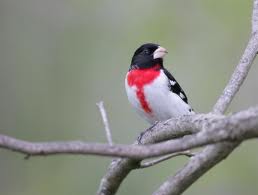
Finally, this week, I saw my first (and only) rose-breasted grosbeak. What an amazing bird. Unfortunately, this one had been hurt. I found him sitting in the middle of the road near OSU. I shooed him into an empty field as  he couldn’t fly; something appeared to be wrong with his wing, probably from flying into a wall of glass in one of the nearby buildings. Since I was on my way to a meeting and had nothing to catch him with, I called Pete, who wasn’t home. He came down later to look for the bird – no luck. I am hoping that he was well enough to fly on his own. But such a beautiful bird. The red feathers were so vivid; I could really see them as I was about two feet away. Pete said he used to see grosbeaks all the time in Connecticut. They are native to Ohio, but this is the first time that ever laid eyes on one. Quite the sight; I hope to see more! Until next time.

Wood Thrush in Glen Echo

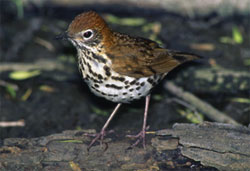
Pete mentioned that he has heard a wood thrush in Glen Echo Ravine, although he’s not been able to actually see it. It’s a very beautiful bird, one of the most common woodland birds of the East. The Wood Thrush is best known for its hauntingly beautiful song. A large and heavily spotted thrush, it is a bird of the interior forest, seldom seen outside the deep woods. We are heading down to the ravine this weekend (if it’s not raining!) to have a listen.

We want to have a survey done of birds that are in the ravine now and in a few months, so that we can see how our removing invasive species and adding native species will affect the birds that visit. Having a wood thrush is a good sign that things in the ravine are heading in the right direction.

Pete has also spent a lot of time looking for a Chinquapin Oak (Quercus muehlenbergii) that’s somewhere in the ravine as well (perhaps with a wood thrush sitting in its branches?) He’s managed to find the leaves but not tree.

If you see the bird or find the oak, let us know!

Until next time!