Author Archives: kkovarik

Comprehensive Neighborhood Stormwater Solution

This is a guest blog by Clintonville resident Andrew Overbeck, an urban and regional planner for MSI Design who has worked on several sustainable stormwater improvement plans and projects in Central Ohio and across the region.

The Lower Olentangy Urban Arboretum tree planting initiative, various rain barrel programs and the revegetation of the ravines will all go a long way toward enhancing Clintonville’s neighborhood aesthetic and benefitting the environment. However, more can be done to effectively treat the stormwater that is generated by our neighborhood roads, sidewalks, homes, parking lots and other impervious surfaces. While some homeowners and neighborhood organizations have installed rain gardens, a more comprehensive approach could be taken to effectively manage, treat, and infiltrate stormwater in our neighborhood before it enters the combined storm sewer and ravines.

There are numerous approaches to sustainable stormwater management, but one of the most effective solutions could be the addition of curb extension stormwater planters. What is a curb extension? It is a stormwater planter that extends the curb into the parking or travel lane of the street and transforms it into a landscaped area that treats stormwater and provides temporary retention and some infiltration.

Along with tree planting and traditional engineering solutions, these so-called “green streets” are being used effectively across the country, most notably in Portland, Oregon. Locally, the Village of New Albany recently unveiled a comprehensive stormwater strategy that includes these and other green infrastructure solutions, including pervious paver streets

What could these look like in Clintonville? Placed at the bottom of every block heading west toward High Street, the curb extensions could capture all of the water running off the street, including the any water directed toward the street from sump pumps and gutter outlets. Given that our streets are “yield streets” these would have to be designed and located to allow for clear turn movements. Designed correctly, these could result in minimal parking loss and maximum environmental gain.

As the Lower Olentangy Urban Arboretum continues to evolve, this could be part of the long-term vision for the environmental sustainability of our neighborhood.


Keepin’ Cool

It’s on days like today – sunny, hot and humid – that make me very thankful for the shade that trees provide. I’ve got it down to a science how best to navigate the trip from the bus stop to my home. I know exactly which route has the most shade, when I need to cross the street, when I know I’ll be in the hot sun for a few minutes. The difference in temperature between shade and sun is amazing. By shading surfaces like asphalt, roofs, and concrete sidewalks, those surfaces don’t heat up and trap the heat, keeping temperatures lower.

I read about an experiment that NASA did in Huntsville, Alabama, recording the difference in temperature around a mall parking lot. The experiment showed that wherever trees were planted, temperatures were reduced by 17.2° C . Pretty amazing. There’s also a web site that has a slide show showing the changes in temperature over a period of nearly 20 years for Atlanta, Georgia, as trees were removed. It’s a very telling story.

I only know that I feel much cooler in the shade than in the sun!

Until next time!

Results of Our First Public Meeting

Our first meeting went so well! Around 30 people were in attendance, a wonderful turnout. We covered the history of the arboretum and the timing for the tree planting this fall. Then the real magic started with comments and suggestions from the attendees. So many great ideas were given, some we had thought about but many that we hadn’t. That’s the power of brainstorming. Here’s just a few of the amazing suggestions we got:

  • Partner with local schools
  • Reduce storm water run-off through catches at the end of streets
  • Go back to brick streets
  • Encourage backyard gardens; link when possible
  • Have education / workshops for arboretum residents; gardens, herbs, rain barrels, etc.
  • Have a bird survey completed; make the arboretum a bird sanctuary
  • Bury electrical, cable, and phone lines, or beautify utility poles
  •  Install planted medians on High and Indianola
  •  Have a plant share / trade day
  •  Provide educational information on newly planted trees, especially for rentals
  •  Create neighborhood stewards for areas with large number of rentals
  •  Create and install signage to delineate area
  •  Plantings to attract bees / pollinators ; butterfly way-station
  •  Beautification projects – little green spaces /plants, businesses, etc.

These are all fantastic ideas for things that we can do within the arboretum in addition to planting trees, all of which will make the arboretum even better than we had envisioned. So thanks to everyone who came and participated; we can do so much more together.

Until next time!

Rain Barrels and Storm Water Run-Off

With all of the rain that central Ohio has been receiving (although it’s hard to remember the cold, damp, rainy days of a few weeks ago with the temperatures now in the 90’s outside), there has been an increased amount of stormwater getting into our streams, rivers, and sewer systems. Unfortunately, this water contains many contaminants: pesticides, road salt, oil, gas, sediment, nitrogen, and phosphorous. These pollutants come from a variety of sources, including pet waste, lawn fertilizers, cars, construction sites, and pesticide application. All of this means that the health of our waterways suffers.

An easy and simple way to cut down the amount of stormwater getting into our waterways and sewers is to use rain barrels to collect run-off from roofs. Pete rain-barreland I have two connected rain barrels at our house and are contemplating a third barrel. We seem to have run out of downspouts to use! One of our downspouts  is emptying into our rain garden that we’ve created in part of our backyard. (We’ll have more on rain gardens in another post.) These barrels are wonderful for watering our indoor plants, and my cottage garden, which is made up of a mix of native and non-native plants.  It’s the non-natives that require more water.  On top of all of that, rain water is pure; it doesn’t contain dissolved substances (like salt) that can be found in city water. Salt water is fine for boiling pasta but not so good for plants. And we save money, too, on our water bill.
The Franklin County Soil and Water Conservation District and FLOW (Friends of the Lower Olentangy Watershed) have teamed up to help homeowners get rain barrels.  FCSWD has a lot of information about installing rain barrels as does FLOW.

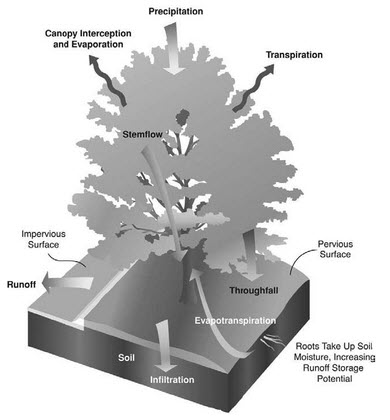
In addition to rain barrels, one of the benefits of trees is that they are very helpful in keeping stormwater out of our sewer systems and streams and rivers. Their roots help to drive water deep into the soil, and their canopies help to store rain water to later release into the atmosphere. Trees additionally provide other benefits: lower temperatures in the summer, lowering cooling costs, better air quality, habitat for wildlife and birds, not to mention that they are beautiful to look at!

Until next time!

Baby Finch Update

Well, it hasn’t gone very well for our nesting house finches. The second nest built by the first pair was also destroyed by a bird, perhaps a cowbird. The nest was moved and Mama Finch didn’t come back. There was one baby that had hatched and left all alone. Having no idea what to do with the little guy, I ended up doing nothing. I was afraid to feed him for fear of giving him something that would kill him. But I knew that if I didn’t feed him, he’d most likely die. I thought I could get him to the Ohio Wildlife Center if he made it through the night. Poor little lamb didn’t.

But there was another egg that had partially opened with the chick still inside; he was moving inside the egg, which was cracked and open. With the help of two special friends, Dan and Mike, the nest with its one remaining baby made it up to Ohio Wildlife Center. Last we heard, the little guy was taking nourishment. I am hopeful that he’s going to make it. They are pretty wonderful up at the center, taking in the baby rabbits and birds that we’ve found. It’s nice to know there is someplace to take injured and sick wildlife. And it’s also nice to know there are people out there who wouldn’t bat an eyelash at saving an unhatched egg – thanks just doesn’t seem to be enough.

The second pair’s nest was also destroyed with no sight of the eggs or babies. I know that these things happen in nature, but it is very sad to me; I feel like these finches are part of our family, a part that I want to protect.

Until next time.

May 21st Clean-Up in Glen Echo Ravine

Sorry for the delay with a new post. Between the electrical storms (computer shut down), and a mad dash to clean for my mom’s visit Thursday, I’ve been remiss in putting anything up on the web. My apologies!

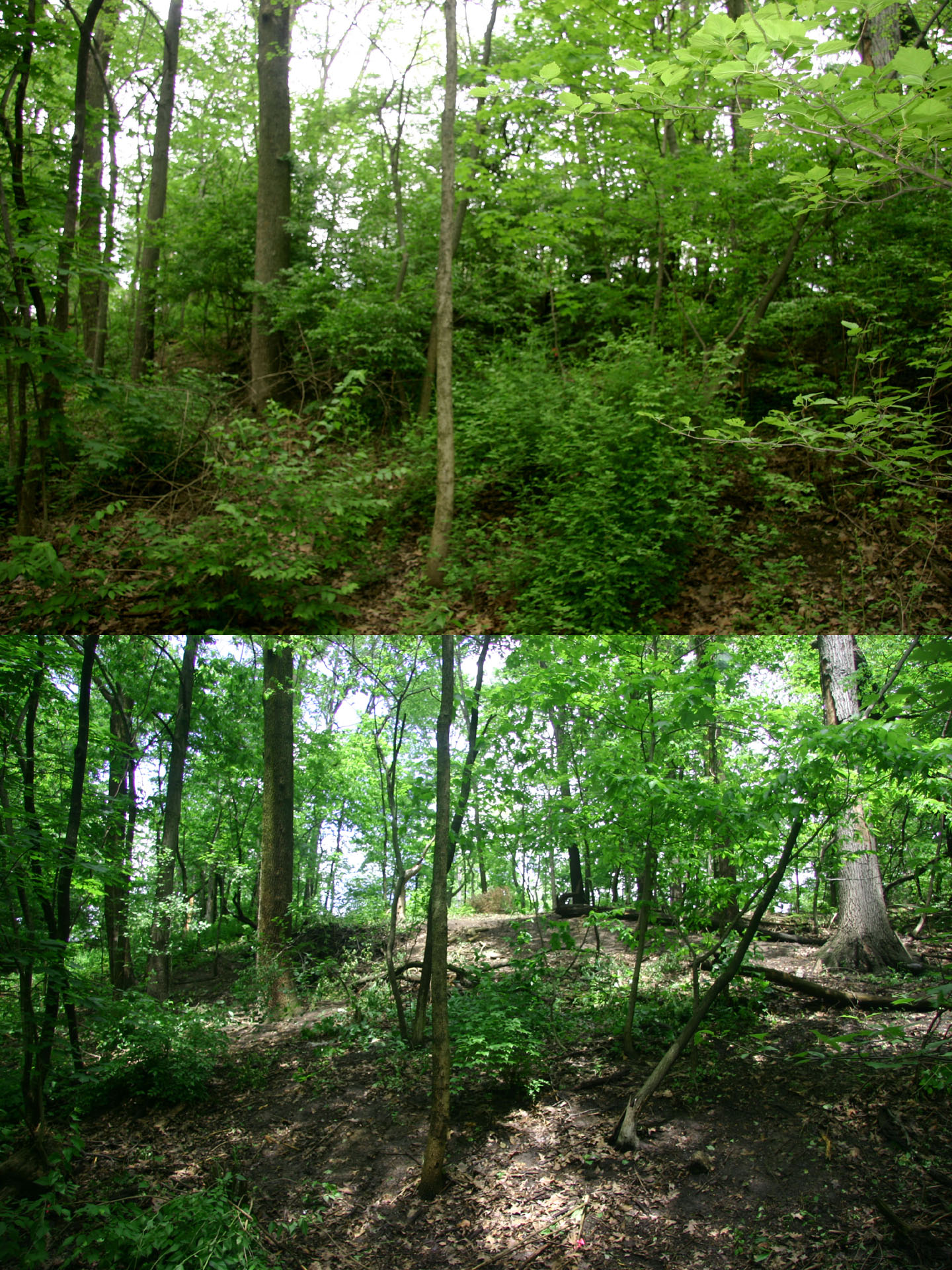
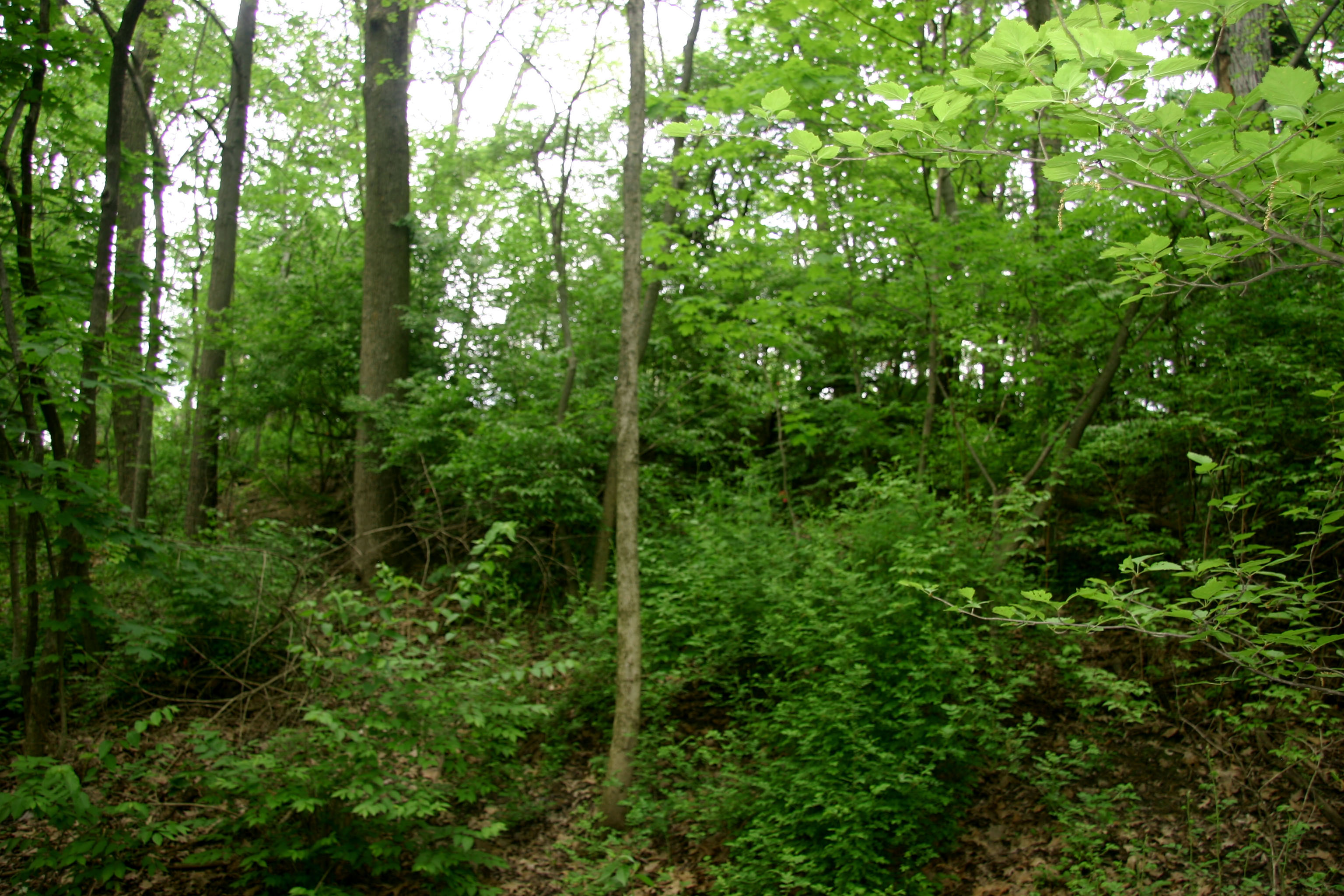
We had another very successful clean-up on May 21st in Glen Echo Ravine. Pete had nearly 30 volunteers that came to help remove honeysuckle. About 1/2 acre was cleared of approximately 100 honeysuckle bushes. Here’s what it looked like before work was started:

Before

Quite a lot of honeysuckle to be seen, choking out the native plants.

Here’s what it looked like after everyone left:

After

What a difference! This will allow more native wildflowers and plants to thrive. Pete will also now be able to plant some spice bush and a few trees in this cleared area. To really see the difference, here is a composite before and after:

You can really see how much honeysuckle was removed. We owe a big thanks to all of the volunteers from Columbus State and Ohio State, and to all the others who came to work in the ravine. We couldn’t make this happen without your help!

Slowly but surely, we are making a difference. We also have some new information about garlic mustard (another wicked invasive), which is growing voraciously in the eastern part of the ravine, just before the bridge. Pete heard that wild ginger, once established, will fend off garlic mustard. So we are going to try and establish more colonies of the wild ginger.

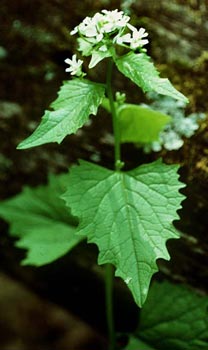
In case you are wondering what it looks like, here’s a picture of garlic mustard. It’s all over Columbus, even in people’s yards in Clintonville. It’s easily removed as the roots are never very deep in the soil. Unfortunately, garlic mustard is

Garlic Mustard

very good at reproducing, casting hundreds of seeds over the ground. For more information about this invasive, you can go to the Ohio Department of Natural Resource page about the plant. The scary part about this plant is how tenacious this plant is: A plant can produce seeds after it has been pulled up and seeds are viable for at least 7 years. If you see this plant, pull it out and dispose of it properly. The ODNR site has some tips.

Until next time!

Birds in our neighborhood

Today, I saw a mated pair of Cooper’s hawks flying above our house on Crestview. I think they have nested in the large oak tree down the street from us. We also have two pairs of finches (house finches, I think!) nesting in the ferns in hanging baskets on our porch. I call them Mama and Papa Finch. One nest has five light blue eggs in it; the other nest is just in the beginning stages of being built. Finches have been nesting in our ferns for about four years in a row. The finch’s song (at least the male’s) is so lovely to hear. I greet them whenever I walk out our front door; I think they might even recognize my voice. I can’t wait until the babies are hatched. Speaking of bird songs, I heard the elusive wood thrush in the ravine. The recording I placed in an earlier post doesn’t do the song justice. Very beautiful and haunting. I think hearing it in the ravine made it all the more beautiful. Pete says it’s his favorite bird call.

Finally, this week, I saw my first (and only) rose-breasted grosbeak. What an amazing bird. Unfortunately, this one had been hurt. I found him sitting in the middle of the road near OSU. I shooed him into an empty field as  he couldn’t fly; something appeared to be wrong with his wing, probably from flying into a wall of glass in one of the nearby buildings. Since I was on my way to a meeting and had nothing to catch him with, I called Pete, who wasn’t home. He came down later to look for the bird – no luck. I am hoping that he was well enough to fly on his own. But such a beautiful bird. The red feathers were so vivid; I could really see them as I was about two feet away. Pete said he used to see grosbeaks all the time in Connecticut. They are native to Ohio, but this is the first time that ever laid eyes on one. Quite the sight; I hope to see more! Until next time.

Portal Park Clean-up

This past Saturday morning, May 14th, Sue Wightman led ten volunteers in sprucing up the plantings in the Welcome to Clintonville Park at the arboretum’s southwest corner, High and Arcadia. Dead plants were removed, others were pruned, many hostas were planted, and new petunias were placed in front of the park’s sign.

Sue and her volunteers have been instrumental in turning this park around and improving its look ever since the United Crestview Area Neighbors, the civic association north of Glen Echo Ravine, officially adopted the park five years ago by signing a maintenance agreement with the City of Columbus’ Department of Recreation and Parks.

Currently, Sue is working with both the Univeristy and Clintonville Area Commissions, as well as city government, to improve the seating, signage, and other hard scapes within the park.

Many area residents have come to know this area as the Portal Park because it is an entryway into both commission areas, as well as the arboretum and Glen Echo Ravine.

If you are interested in joining Sue and her volunteers in improving this park, please write her at Susannewightman@ymail.com

Earth Day Follow-up Work Session: May 21

We’ll be having another session in Glen Echo Ravine to remove invasive species, especially honeysuckle. We are now the proud owner (at least temporarily!) of a honeysuckle popper, guaranteed to remove honeysuckle in one “pop.” Pete’s not tried it, so we aren’t sure how it will work, although others who have used it say it does the trick.

The session will be from 9 AM – 1PM on Saturday, May 21, 2011. The area of the ravine where we will be working is located near the Indianola Bridge in between Cliffside Drive and Olentangy Street. You can park along Indianola or one of the side streets near the ravine. There is a stairway on the Northeast side of the bridge that leads down into the ravine. At the bottom of the stairs, head west (to your right), go under the bridge and follow the trail west through the cleared area. We will be working in the woods just beyond. If you have work gloves, please bring them. There is some poison ivy present so dress accordingly.

Please RSVP to 614.261.0092.

See you there!

Upcoming Public Meeting: May 24

The Lower Olentangy Urban Arboretum will have a public meeting on:

Tuesday, May 24, 2011
7-9 PM
Crestview Presbyterian Church
350 E Tulane Road

The meeting will be in the church’s basement; please use the Esmond Street entrance.

Agenda

  1. present a brief history of the arboretum
  2. outline future plans for this fall: reforestation of tree lawns and right-of-way areas with native species canopy trees
  3. discuss what other items arboretum residents might want to see as part of the overall arboretum plan

For more information:    614.261.0092

Hope to see you there!