Category Archives: General Information

Water Conservation

As Pete and I were running some errands yesterday, the usual comment about how hot it was outside (and humid!) came up. I mentioned to Pete that although it has been very hot and humid (with temperatures over the norm for most of July), we weren’t in drought conditions like other parts of the country, that we had received a lot a rain as well. So imagine my surprise when I read “Today’s Weather” in Sunday’s Dispatch (hoping to see something without the words “hot” and “humid” in the forecast) that the Water Report for Central Ohio was “Dry,” meaning: “Use water only as needed.” I was also surprised to read that with the exception of Griggs Reservoir (with a whopping surplus of .017 feet), all the other reservoirs were below normal. Now granted, the amounts weren’t huge, with -1.41 feet below normal being the lowest level at Hoover. But I had been certain that with all this rain, those levels would have been above normal.

One very simple thing that homeowners can do to conserve water is to collect rain run-off. I’ve mentioned that Pete and I have two rain barrels. They’ve been pretty full for most of the summer and are used to water our vegetable garden, newly-planted greenery and the plants on our porch and inside the house. This water is especially perfect for our indoor plants because it doesn’t contain dissolved solutes like city water does which can’t easily leach out. The other downspouts that we have are directed into several rain gardens, keeping much of our water out of the storm water system.
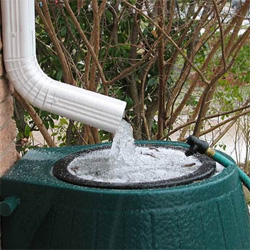
In addition to rain water, we try and collect other “waste” water from the house: the water from the cat’s water bowl, and the water that runs while we are waiting for the shower to heat up. We use buckets to save this water to add to the rain barrels or water outdoor plants because any solvents in the water will leach out whenever it rains.

All of this adds up to savings for us and the planet. The rain isn’t going over concrete or other impermeable areas, picking up all sorts of chemicals and other bad things, all which end up in the Olentangy River (in our case). Having the water kept on our property helps to have the ground filter out much of the chemicals before the water gets into the water table. According to the EPA, lawn and garden watering accounts for up to 40% of water use during the summer. The EPA also indicated that the average homeowner will save about 1300 gallons of water each year by using a rain barrel. I tried to figure out how much money that would translate into, but the City of Columbus Public Utilities website was beyond me. Their rate chart would confound an accountant…

So I hope by now, all of you reading this are wondering, “Where can I get a rain barrel?” Well, there is a rain barrel workshop scheduled at the Whetstone Library on August 25 at 6.30 PM. [There are others scheduled as well.] You need to be a resident of Columbus and must register along with advanced payment of $45 to the Franklin Soil and Water Conservation District. Here’s the link: http://www.franklinswcd.org/columbus-rain-barrel-program/columbus-rain-barrel-workshops/

Until next time!
8.3.11 LOUA Meeting

We had our monthly LOUA meeting this past Wednesday at our house. It was one packed meeting, and we weren’t even all there, missing a few members who were unable to attend; we may need to find a bigger space in the future! Our merry little band has grown to 14 members. It’s great that so many people are interested in the Arboretum. I won’t bore you with all the bits about the budget and volunteer hours, but there were some other pretty exciting parts of the agenda.

One of the discussions revolved around the amount of trash that is getting into the ravine through the run-off from I-71. The clean-up on Saturday showed just how much trash comes in with heavy, torrential rains. We really need to stop the garbage before it comes into the ravine; picking up trash around Silver Drive and I-71 will only alleviate some of the problem as most of the garbage is washed down from I-71 and therefore, not easily picked up.

We’ve also made good progress on the two walking tours of significant trees within the Arboretum. There will be both a long and short route. All the possible trees have been identified, so it’s now a matter of creating a path from tree to tree for a lovely walk that offers a nice mix of all the types of trees we are lucky enough to have in our neighborhood. The trees highlighted in the walking tours will be the best, easily-viewed examples within the Arboretum. We also received the city’s list of places where trees can be planted in the fall. With an exact number of trees, we can begin to work on figuring out what trees we need to have at hand: how many oaks, how many hickories, etc. This is really coming together. I can’t wait until that first tree is ready to be planted as I know it will be a celebration and culmination of all of our hard work.

The best part of the meeting (at least in my opinion!) was seeing Jake Boswell’s sample of the markers for the trees. The design isn’t quite finalized, so I can’t show you just yet what they will look like. I promise I will as soon as we have the final version. But I must admit that the marker is beautiful, informative and best of all, inexpensive. These are the markers that will be placed by the significant trees on the walking tours, giving those on the walk a little bit of information about the tree: species, common name, the like.

I think that about covers it.

Until next time!

Ravine Clean-up Update and Other Things

I just wanted to let everyone know how the ravine clean-up last Saturday went. I could only stay for about an hour as my allergies would get the best of me had I stayed longer. As it was, I was very stuffy all of Sunday!

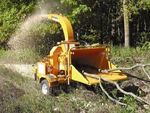
Anyway, the day went better than expected as far as the amount of invasives that were removed.I wasn’t surprised on the number of people who showed up to volunteer. A big thanks to everyone who turned out: members of Friends of the Ravine, Lower Olentangy Urban Arboretum, interested neighbors, Boy Scouts, too many groups to name them all. And a really big shout out to Carl and Tyrone from the City of Columbus. They brought a huge chipper and a chainsaw that made short work of all of the honeysuckle. Carl then went back to paint all the stumps with herbicide so they wouldn’t grow back. Pete took me to see the part of the work that was done at the western edge of the ravine by the Xenos School. Unbelievable. What had once been a forest of invasive honeysuckle was now clear, the way it was meant to be. The squirrels were wondering around, looking as if they didn’t recognize their home anymore. I don’t blame them – the change was nothing short of miraculous!

It was finally nice enough today for me to walk to work again, although I doubt I’ll be able to do so for the rest of the week. As I walked, I found a beautiful cardinal feather, such a vibrant red. It seems odd to me that with all the birds flying about, there wouldn’t be more feathers! I did miss walking through the Oval and the trees, but my walking route doesn’t take me that far.

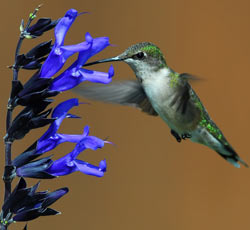
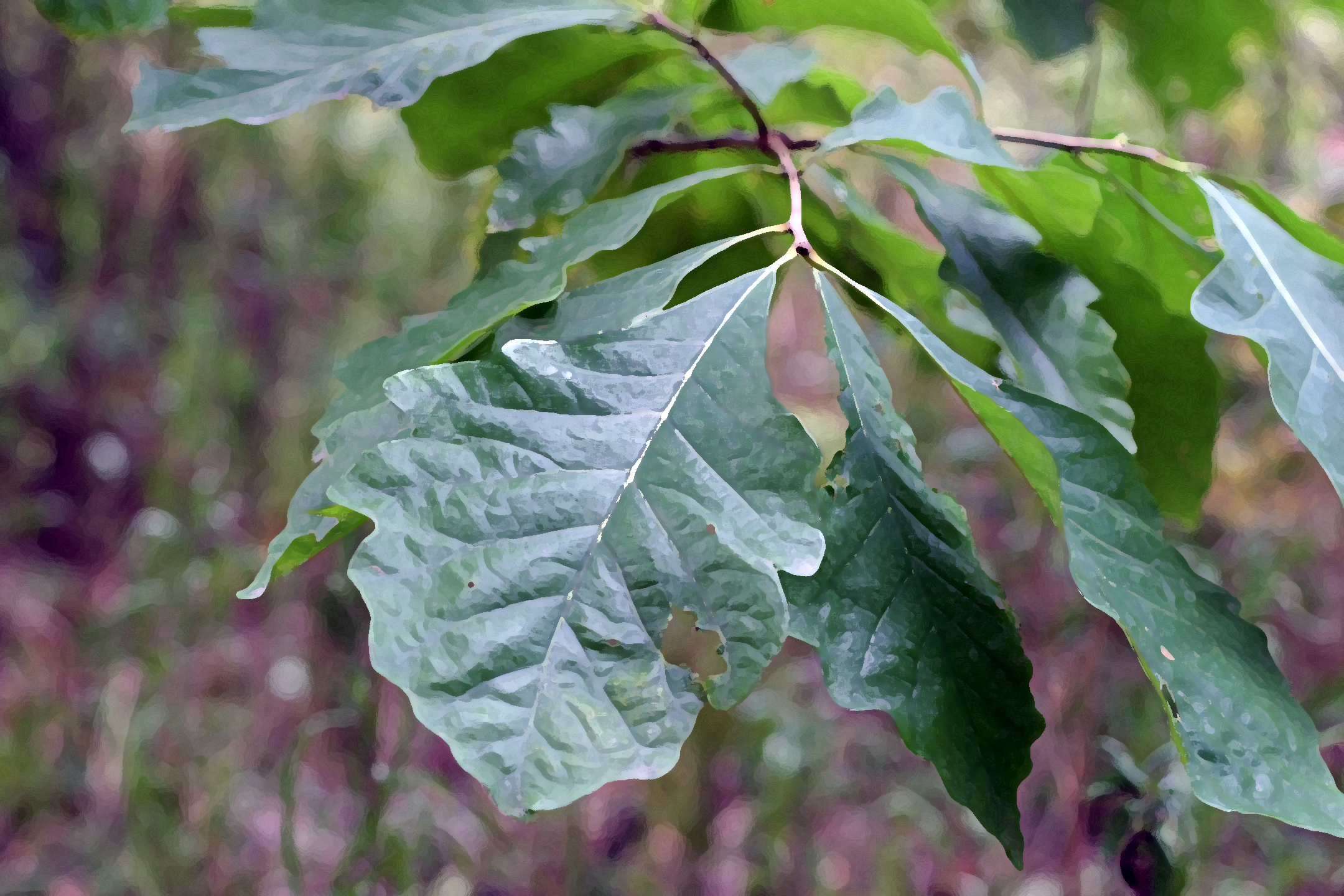
When I came home, Pete had planted our Swamp Oak in the backyard. We’ll be certain to keep it well watered this week with the high temperatures. It’s such a lovely tree, with its bi-colored leaves. The undersides are a beautiful silver color and the tops are a dark, verdant green. As we stood admiring it, a female hummingbird came to sit on the clothesline, just a few feet from where we were standing. I’ve named her Hannah. The funniest thing to hear is the squeaking noise she makes as she moves around. Hannah is very inquisitive and very territorial. Should another hummingbird enter her territory, she’s off in a blur to chase it away. I guess she doesn’t want anyone else sipping from the jewel weed, pineapple sage or other bright red flowers we have in the yard. Such a tiny little bundle of fierceness!

Until next time!

We have a new tree in our backyard

Our newest addition is a Quercus bicolor, or the white swamp oak. It can handle slightly hydromorphic  soils. And no, I had no idea what that word meant (other than something about water) until I looked it up on the Internet: “of or pertaining to soil having characteristics that are developed when there is excess water all or part of the time.” So our new baby will fit in perfectly in our backyard because Pete has made a rain garden back there. The soil tends to stay wetter because of that.

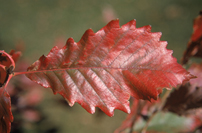
It’s funny that I ended up with this particular tree. There is one a few streets over from our house on the way to the ravine. I always pass under it and comment on how much I loved that tree. The branches are sweeping and have large lobed leaves. It can live 300 years, achieving a height of 65 to 80 feet. The fall color is very nice for an oak, a beautiful scarlet. Pete remembered my love of this tree and got one for me. We will have to keep a careful eye on this little guy as it can form a hybrid with burr oaks, one of which we have in our front yard. I was going to head out to admire and water it, but right now, it is raining cats and dogs. Our rain barrels will be full again! As will our neighbor’s car, whose windows are partially down. I did try knocking on your door, John!

It’s amazing to me that a tree can bring such joy.  I work at Ohio State, and with all of the construction around Bricker Hall, I have to get into the building from the side that faces the Oval. I just love walking under the trees, most of them fairly large, although a few new ones have been added in. There is one, a sycamore (another one of my favorites; I love the bark) that was around in 1776. If only it could talk. There is another special tree that I never knew about after attending OSU for four years and working there for another 11. It’s a lovely oak tree planted in memory of a soldier who was killed in France in 1944. Since I have studied World War II history, I asked the archivist at Ohio State about the tree, and he managed to find me a picture of the young man who was killed. (Sorry, the photo’s on my computer at work.) Neither of us has been able to discover why this particular soldier had a tree planted in his honor. Not that there needs to be a reason; in my mind, they all deserve a tree in their name for everything that they have done.

Well, I am going to sit out on the front porch for a little while; the lightning has let up, and I love hearing the distance rumble of thunder and the rain falling down. I’m certain that the temperature will have dropped with the storm, too. The air will be fresh and sweet smelling.

Don’t forget the clean up in the ravine tomorrow. All this rain should make for easy pulling of the invasive plants! And Pete is famous, having had a front page article in The Booster with his name in it (granted, under the fold) about the clean up. Details are: Saturday, July 30, from 9 – 3. Meet in Glen Echo Park beneath the Indianola Avenue bridge. There’s a map at www.FriendsOfTheRavines.org/

Until next time!

Arboretum Work Update

Things are progressing on getting trees planted within the Arboretum. The City of Columbus has completed its work of  identifying the locations where trees can be planted within the Arboretum boundaries. The trees on this list will be of mixed sizes, including canopy, medium, and small trees. Homeowners who do not opt out of having a tree should see trees planted this fall.

We are also working on the finishing touches for our brochure. This is such an important piece because it will represent what we do and inform so many people. Our group is very excited to see the final product. Much thanks to John Kyrgier  for all of his work on designing the brochure!

And finally, we have made a decision on tree markers for the significant trees that will be highlighted on the walking tours within the Arboretum. We’ve decided on flat native (indigenous?) rocks – no non-native rocks for this group! – that will be spray painted with pertinent information about each tree. We’re still deciding how much information will be on these rocks, but at the least, there will be a number that corresponds with the same number on a map. The map will contain information about the tree itself. Once I get a design, I’ll be certain to post it up on the blog.

As I said, it is really exciting to see something that was just a dream become reality. This will be a lasting legacy for Clintonville, something that will bring joy for generations to come.

Stay cool…Until next time!

Volunteers needed for invasive species removal

There will be another work session in Glen Echo Ravine to remove invasive plants, especially honeysuckle and all of the details are given below. This time the City of Columbus will be lending a helping hand. If you can make it to the event, please let Pete know by phoning him at 261-0092; Maureen of Friends Of The Ravines (FOR) would like to know how many people to expect. Thanks and hope to see you there!

When: On Saturday, July 30, FOR is partnering with the Columbus Recreation & Parks Department, http://parks.columbus.gov/HoneysuckleRemoval.aspx , and neighborhood groups to remove invasives, primarily bush honeysuckle within the Lower Olentangy Urban Arboretum. Volunteers are needed from 9 – 3.

Where: Meet in Glen Echo Park beneath the Indianola Avenue bridge.
There’s a map at www.FriendsOfTheRavines.org/

What to wear/bring: long pants, boots or shoes with good traction, work gloves, hat, and snack/lunch. Recreation & Parks will provide some saws and loppers. If you have tools, feel free to bring them.

Tasks: Volunteers can haul cut plants to the shredder truck, others can remove different types of invasives. Crew leaders will be available for questions and direction. The two person Rec & Parks team will cut honeysuckle and operate the chipper/shredder. There is poison ivy, slopes and uneven ground in the ravine.

FOR will provide: water, sunscreen, insect repellent, poison ivy wash (like Tecnu), rest room facilities (courtesy of Xenos Christian School, Calumet Campus).

Hope to see you there!

Bird Sightings

I hope everyone had a great Fourth of July. Pete and I spent the holiday weekend (along with my mom) in Saginaw, Michigan, visiting with my brother, Mike, and his wife, MaryJo. We had a great time: good food, good company, and great bird watching. Mike’s house is located near a golf course that has lots of tall trees, and his backyard has several mature trees including a towering walnut tree. There are also a lot of shrubs that offer sanctuary for many kinds of birds along with several different kinds of bird feeders.

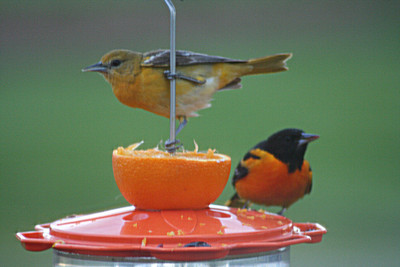
As we sat at the dinner table, MaryJo noticed a yellow bird on the backyard patio that she assumed to be one of the goldfinches that we had seen earlier in the day. But when Pete looked at the bird, he realized to his wonderment that this Baltimore or Northern Oriole pairbird was a female Baltimore oriole. This was really exciting, mainly because none of us (except for Pete), had never seen one in the wild. With the aid of binoculars we each got the chance to see this most beautiful bird. Imagine our surprise, then, when a male oriole came flying in, too! The male is a different color than the female, a bright orange, and very hard to miss. (Note: there are several names for this oriole, including the Baltimore Oriole and the Northern Oriole. Cornell University’s Ornithology Lab calls it a Baltimore Oriole, so I am using that name.)

So with both a male and female Baltimore oriole in the yard, we went to the Internet to see what we could do to provide food. I went to my favorite Cornell University site for some basic information about habitat and food (mostly insects), and that the birds overwinter in tropical areas including Mexico, Central America and northern South America. They come up north to spend the summers to breed. Also, they aren’t true orioles (called such because they resembled similar-looking birds in the Old World) and are more closely related to meadowlarks and blackbirds. A little more digging informed us that these lovely birds are attracted by oranges and grape jelly. Yes, grape jelly. So I got an orange, cut it in half, and stuck it to Mike’s fence, having no grape jelly in the house. Of course, neither bird noticed this treat. The squirrels in Mike’s yard, on the other hand, easily found the sweet oranges.

I’ll have to talk to my brother to see if the orioles have come back and whether they’ve started eating oranges or grape jelly. The one orange that wasn’t devoured by the Caterpillarsquirrels had peck marks in it. Having never seen these amazing birds, it was so special to see them on the wing. Pete said that the habitat in that part of Saginaw was favorable as these orioles need large, mature trees in which to search for insects. Pete also says that we can attract these birds to our arboretum, too, because we want to plant a lot of oak trees, which harbor many caterpillars that are great food for orioles.

Until next time!

Ohio and Alternative Energy

Two cities in Ohio, Coshocton and Newark, are working with two very different forms of alternative energy and fuels. Niama-Reisser, based in Coshocton, Ohio, is working on a high-mileage car that  is capable of 200 miles per gallon. Yes, you read that right: 200 miles per gallon. I don’t pretend to be an engineer, but from what I understood, the engine runs on some sort of centrifugal force.

Now, what I know about centrifugal force wouldn’t fill a thimble. My only experience was a mad scientist experiment that I did in elementary school which involved placing a plant on a record player (that shows my age!) and sending it spinning around. Since the turntable was on its side (I’ve no idea why that was), the whole rotation took on a rather lop-sided turn.  I think the whole idea was to see how the plant would be affected by spinning on its side. However, the length of the experiment didn’t allow much time for the plant to grow, and I think the poor plant was traumatized by constantly falling off the turntable; there’s only so much hold to duct tape.  I think I got an “A,” most likely because the teacher felt sorry for me! But I digress.

The car itself is cute, although I admit, that probably isn’t an adjective that will make all the car-crazy men go rushing out to buy one. But 200 miles per gallon from a diesel engine is pretty darn amazing. I hope this car is on the market soon. Our Toyota gets pretty good gas mileage but no-where near 200 mpg!

The other city, Newark, had put out a request in April for bids for companies to use solar power to run the city’s waste-water treatment plant.  The best part (besides how happy the Earth will be with this clean energy) is that much of the products and work done will come from Ohio companies, creating Ohio jobs.  This is such a wonderful idea. No matter how you feel about global warming (something I believe in), solar energy is better than coal. Coal burning plants place so many chemicals into the air (mercury, sulfur dioxide) that aren’t healthy for anyone to breath in.

And the trees that we will be planting in the arboretum will also help the planet by cleaning up our air and water. It’s all good.

Until next time…and have a happy Fourth of July!

A Shout Out…

We will now have additional help in the ravine through a Boy Scout, Dominic Jannazo, who is working on becoming an Eagle Scout. An Eagle is the highest rank attainable  in the Scouts. Since being introduced in 1911, over 2 million boys have achieved this honor. In order to become an Eagle Scout, a Boy Scout as to have at least 21 merit badges and finish a service project that he plans, organizes, leads, and manages. Dominic has chosen the Glen Echo Ravine as his service project and will be working on removing concrete and  invasive honeysuckle, as well as planting native plants. We are very happy to have Dominic working in the ravine; every set of hands really helps.

Finally, I’d like to wish a very happy birthday to Mike McLaughlin, who has been so instrumental in moving our arboretum forward. He keeps us organized and focused on what we need to do. We’d be lost without his help (and that of all the other members of the steering committee!). Mike had a birthday party last Saturday that was a total blast. He had a dance floor with disco lights and a non-stop dance track playing for several hours. Which begs the question: why is it that I can dance for several hours straight, burning up calories without a thought, and riding the stationary bike for 20 minutes is pure torture? I sweated more on the dance floor!

On top of that, we couldn’t ask for a nicer neighbor, or a better friend. Mike and his husband Dan where the ones who took the baby finch (still struggling to get sout of its shell) to the Ohio Wildlife Center. They both have hearts of gold.

Happy birthday, Mike!

Until next time!

The World Outside

One of the things that Pete and I both enjoy is sitting on our porch, watching

Maeve and Seamus

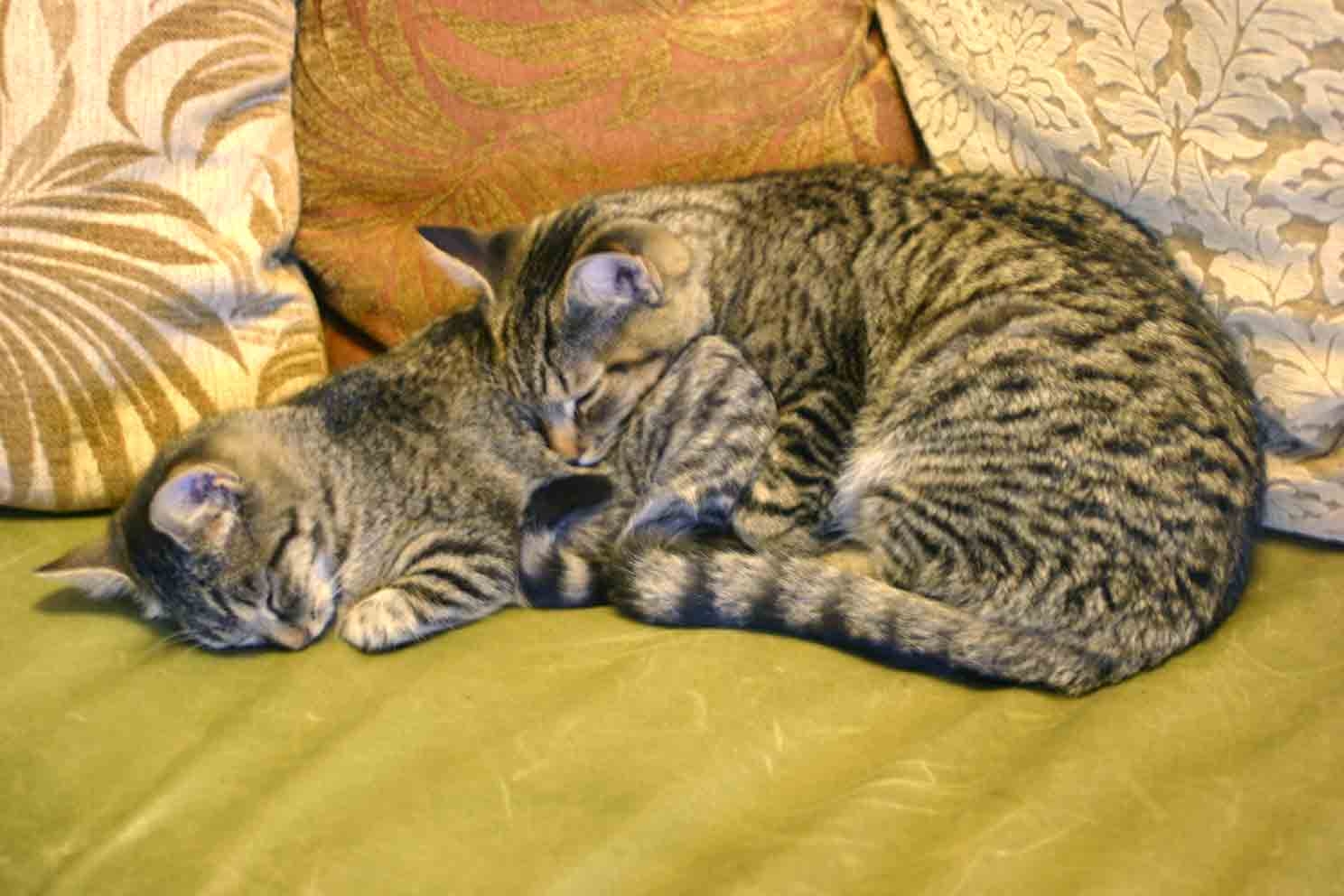
the world that is Clintonville stroll by our front door. If the weather’s nice, we let our cats outside, too, to watch the birds, squirrels and bumble bees flutter around. We have four cats: Fionula, Seamus, Maeve, and Ciara. Got a Celtic thing going on with the names. That’s Maeve and Seamus in the picture.

I know what you are thinking: four cats?! Yes, they are a handful, especially when you consider both Pete and I are allergic to the wee creatures. Pete knew he was allergic before we had cats, and I found out after four were already living in our house. Removing them was not an option!

Fionula is the matriarch of the bunch, being 14 years old. She still holds her own against all the youngsters. Seamus and Maeve are both five years old. Seamus was rescued from my dad’s tree farm, and Maeve, another rescue, came to keep Seamus company. Finally, we have Ciara, who is three, whose previous home was the airport. All of them get along (for the most part – they have been known to hiss at one another on occasion!) and really enjoy being out on our porch as there are always things to see. Or not see, as often, finding a comfortable place to take a nap seems to be a top priority. For the most part, everyone stays on the porch as we don’t allow our cats to go anywhere else.

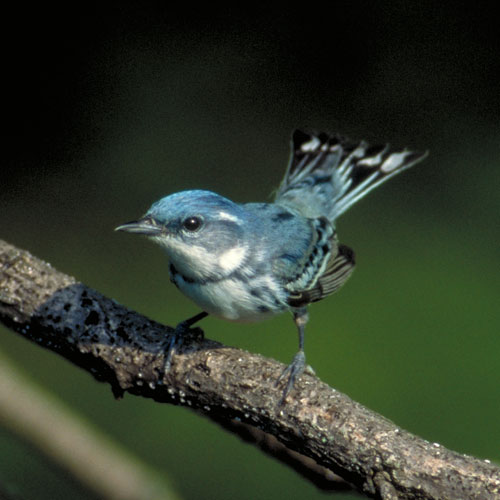
I read a June 12, 2011 article in the Dispatch that indicated that as many as 1 billion birds are killed by feral and domestic cats each year. The article continued to say that some of the birds being killed were migratory birds who winter in South and Cerulean Warbler Central America. These birds are facing loss of their natural habitat and are slowly losing numbers. The same problem is happening here in Ohio, with habitat loss and fragmentation decreasing the numbers of certain birds such as the Cerulean Warbler, whose population has declined by over 80% in the last 40 years. This particular bird lives in deciduous forests, something that the arboretum in trying to increase. More trees will mean more birds.

Until next time!