Author Archives: kkovarik

News from Michigan

Pete and I were in the State Up North over the July 4th weekend. We always have a great time up there: good company and excellent home-made food cooked by my brother, Mike. And his wife, Maryjo, makes the best salads ever. I don’t know if you remember, but Mike is the Squirrel Whisperer; Maryjo can now call in the squirrels, too. Well, Pete and I got to feed a few squirrels, too, along with some blue jays, all of which love peanuts.

The squirrels are usually pretty tentative when they first come into the yard. The route from where they are to the peanut in your hand is usually not a straight one. But after a few peanuts, they become more bold, coming up in a straight line to take the peanut right from your fingers. What amazed me was just how gentle they were. It could have been a fragile egg, they handled it that gently.

The other really cool thing that we experienced at Mike’s house was a cicada killer, a wasp that paralyses a cicada, drags it into a hole it’s made, lays an egg on the insect, then fills the hole back in. The egg hatches and feeds on the still-alive cicada. Kinda gross! But Pete says that cicadas harm trees, and the cicada killer is just doing its thing. I actually thought to grab my iPhone and take a video of the cicada killer flying around with the cicada. It’s pretty amazing when you look at the size difference how the cicada killer could even make it off the ground.
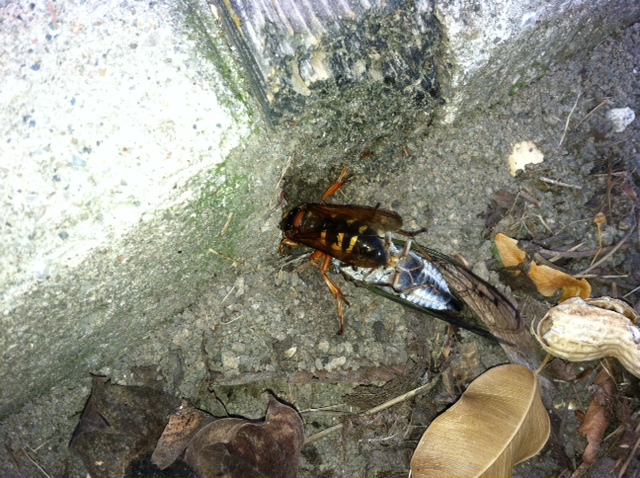
You can see by the photo above just how large these wasps are. The cicada killer was trying to drag the cicada into the wrong hole. It took it a few tries to find the correct one. These wasps are so striking in their coloration. I remember the first one I saw here at our house; it was digging a hole near the front steps. I had never seen such a big wasp so I yelled for Pete to come and look. He immediately said, “A cicada killer…cool!”

Once we came back from Michigan, it was off to the LOUA monthly meeting. It’s really great to hear how word of our little arboretum is spreading. Pete has seen several people looking at our tree (which in on the Indianola Walk), map in hand. In fact, he saw a couple at the kiosk and stopped when he saw they were returning a map. Seems they were from near Youngstown and had come down to the Short North to do some shopping. They saw the kiosk and decided to see what it was for. One look and off they went, map in hand, shopping forgotten. Pete said they even wanted to donate to LOUA.

I still find it hard to believe that we have done something so wonderful. Thanks again for everyone’s support.

Hope to see you all at the Glen Echo birthday bash tomorrow!

Until next time!
Glen Echo Birthday Party :: July 14, 2012

Columbus 200/Glen Echo Park 100 Celebration
Saturday, July 14, 2012 Schedule of Events

Prizes donated by area businesses
will be announced throughout the day.

10:00 a.m. to 11:30 a.m. – Children’s Activities
Face painting, butterfly tattoos, scavenger hunt, nature painting, games, paper crayon rubbings, with a balloon sculpting clown making a special appearance.

11:30 a.m. to 12:00 a.m – Bird Mural
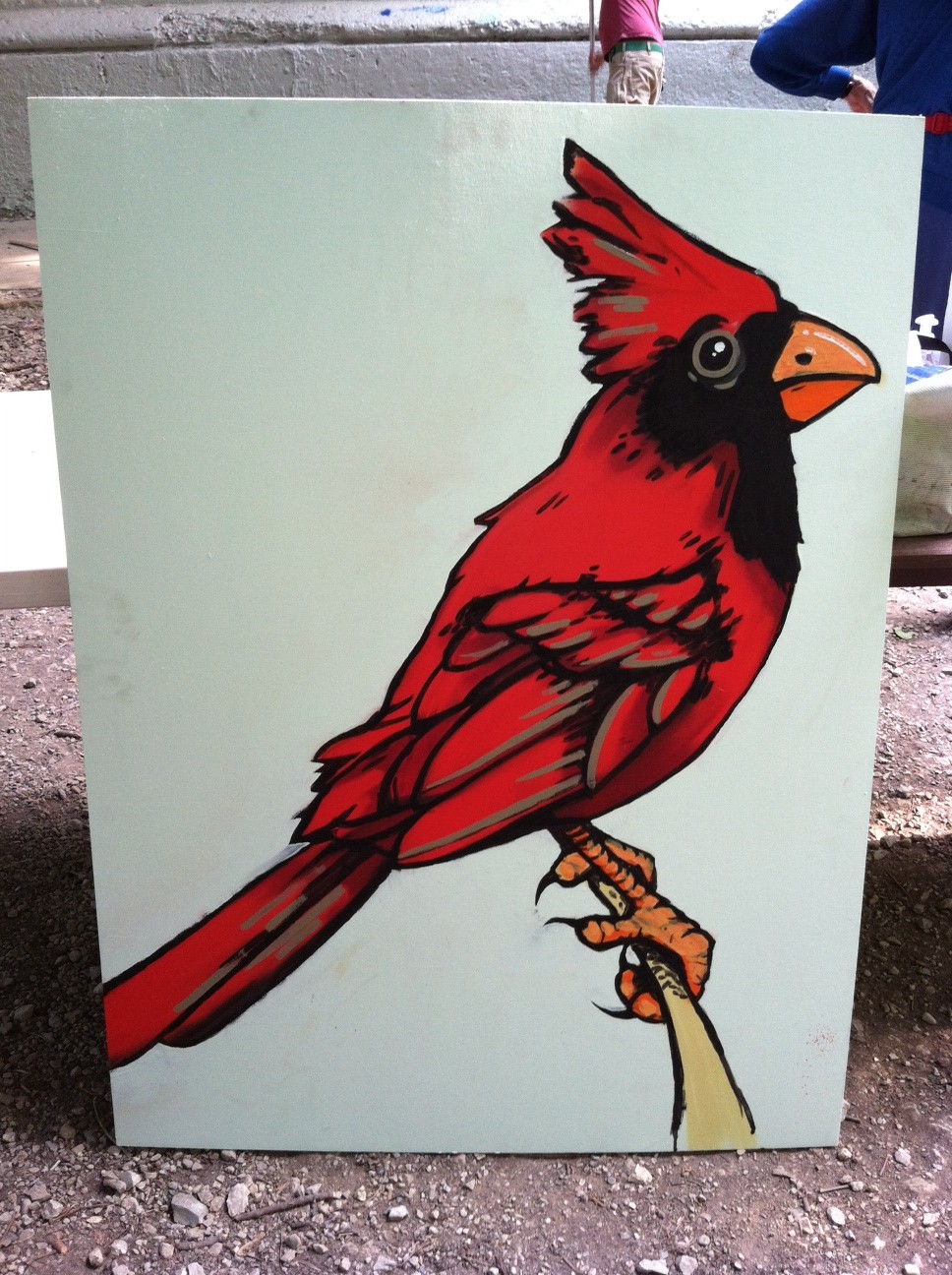
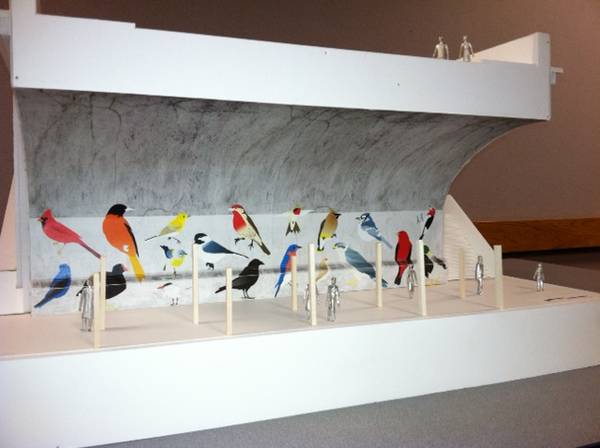
Unveiling of the bird mural beneath the Indianola Bridge and dedication of refurbished signage and the Columbus 200/Glen Echo Park 100 commemorative black gum tree.

12:00 p.m. to 1:15 p.m. – Picnic in Glen Echo Park
Grilled hot dogs and trimmings, White Castle sliders, side dishes, and birthday cookies donated by Mozart’s Viennese Bakery and Whole World Natural Foods.

1:15 p.m. – 2:00 p.m. – Surprise
Join us for a Magic Show featuring Magician Marty Moe Miller.

At the end of the festivities, grab a trash bag and a pair of nifty nabbers and help pick up Glen Echo Park!  Nabbers and trash bags will be at the Friends of the Ravines tent.

Anytime during the day, you can stop at the Lower Olentangy Urban Arboretum tent to select and reserve a native tree for your yard.

This event is made possible, in part, by Columbus200, GCAC, and Chase Bank in cooperation with ALTernative, Friends of the Lower Olentangy Watershed, Friends of the Ravines, and Lower Olentangy Urban Arboretum.


Blow, winds, and crack your cheeks! rage! blow!

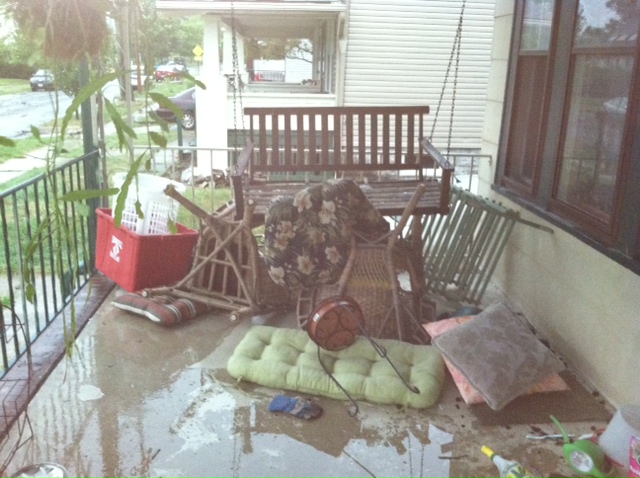
After yesterday’s storm, I believe Shakespeare’s King Lear got it right. The winds were certainly raging yesterday. I hope that all of you survived with homes and health intact. Pete had given me a call at work, letting me know that a line of bad storms was heading our way. I took a look at The Weather Channel online and rushed downstairs to tell my co-workers that they needed to head home. The sky looked a little dark, not too bad. That rapidly changed as I drove home, about a ten minute drive. When I pulled into the driveway, Pete was pulling potted plants into the garage. We managed to switch out the cars so mine was protected by the house before all hell broke loose. I’ve been through a tropical storm and three tornadoes. I’ve never been so scared as I was yesterday afternoon.

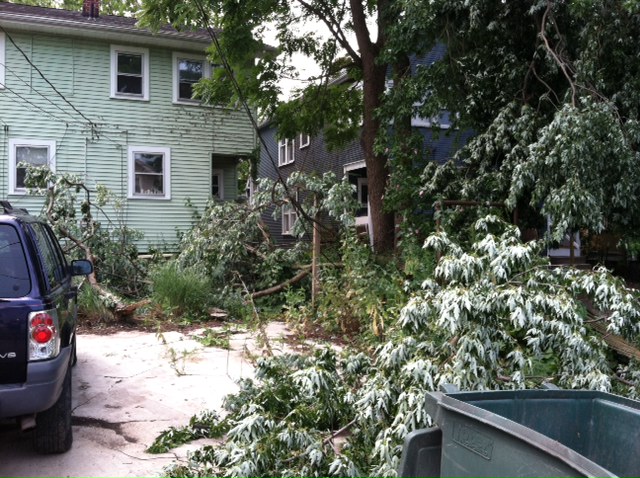
The trees were bending sideways, Rumpke containers were racing down the street, and transformers were flashing. We were trying to save the plants on the front porch, bringing them inside as quickly as we could. Once the porch furniture began to fly across our porch, I told Pete to get inside and stay away from the windows. (You can see the end result of the wind in the picture.) I kept expecting the power to go off, but with only a few flickers, it stayed on; we are so thankful for that. Our neighbors across from us are without power as are some others we know nearby.

After the storm was over, I walked around the neighborhood, taking in the damage. The box elder up the street lost a large limb and is most likely beyond saving. The silver maples were split, limbs everywhere. This picture was taken in the alley behind our house. We saw few oaks down, a testimony to their strength. The large pin oak down the street was fine, and it is probably the largest tree in our neighborhood.

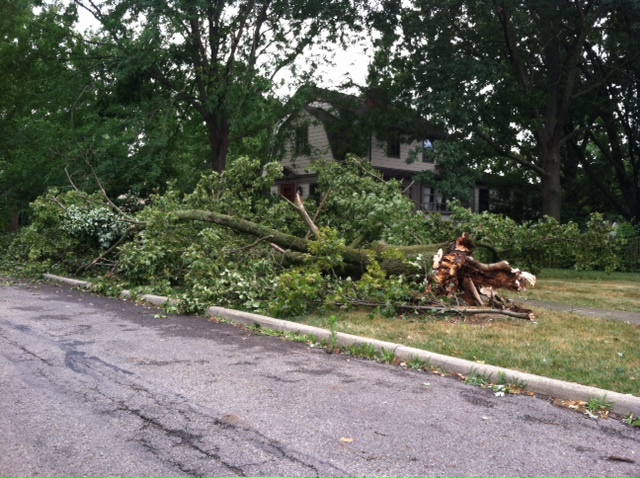
Today, we went out to run some errands and saw trees down everywhere along with power lines. Most of the trees were silver maples like the one in this picture. Down by the Ohio State Med Center, where construction is going on, I marveled that the cranes, so high up, were still standing. With the Dispatch reporting 82 mph winds at Don Scott Airport and power outages all over Central Ohio, I have no idea how they managed to stay intact when billboards were flattened and awnings ripped to shreds.

Again, I hope that all of you managed to weather the storm in good health. If you have pictures or stories to tell about your experiences yesterday, please let me know. I hope that this isn’t how our weather will be in the future. Pete believes this is a harbinger of things to come because of global warming. OSU professor Lonnie Thompson would agree, as this article shows. Just another reason to plant more trees and do whatever else we can to protect our planet.

Until next time.

For Everything A Time

This last Saturday, Pete and I went up to see my dad, who lives in Utica. I don’t remember if I’ve mentioned, but my dad has cancer. They don’t really know what kind of cancer it is so fighting it with chemo is difficult. Dad is very upbeat about his chances of staying around for more time than his doctors have told him. But regardless of how long he is around, he’s left a legacy behind that will live long after he’s gone, much like our little arboretum.

When he bought it, my dad’s property was just a large plot of land devoid of tree except for one very large and very beautiful oak and a large pond. Over the years that he’s had the property, he’s added new trees each year, making what will surely become a forest right next to his house. Dad is not strong enough to walk too much now, so he bought an electric golf cart to get him around his property to see how his trees are doing. He knows them all and can tell you when they were planted and where they came from. It was really nice to learn so much about his trees; he’s very proud of all that he’s planted.

What also made am impression on me what the number of birds that were flying around. I saw robins, mockingbirds, and native sparrows. We heard red-wing blackbirds and Pete said he saw an indigo bunting (yes, once again, I missed seeing that bird – I was helping my dad with his license plate collection.) As we rode around in the golf cart (only slightly fearing for our lives as Dad cut it a tiny bit close around some trees; Dad’s comment was, “They won’t hurt you!”), a fledgling sparrow (not an English one, Pete assures me!) flew out of the trees and landed on Pete’s pants pocket. I don’t know who was the more surprised: Pete, me, or the little bird. It only took the little tyke about two seconds to realize that he wasn’t where he should be. Mama Sparrow wasn’t too happy with us, either, keeping up a scolding chatter the whole time.

Anyway, what my dad has done has created a legacy of trees that will last long after he’s gone, just like the trees we are planting in our Arboretum. Will Dad’s trees stay around after his property is sold? I don’t know, but I hope so. Things do change no matter how much we would like them to stay the same. Like this story I read in today’s Dispatch about the second largest burr oak in Ohio having to be cut down because it was becoming a danger with a hollow core. It was around in the early 1700s, and if that tree could talk, I am certain it would have so much to say. I wonder how many generations of birds have been born, found shelter or food within its branches.

Until next time.

It Takes A Community…To Create A Mural

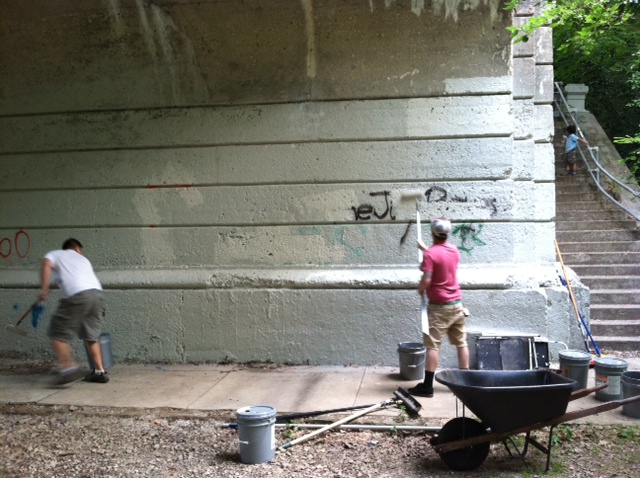
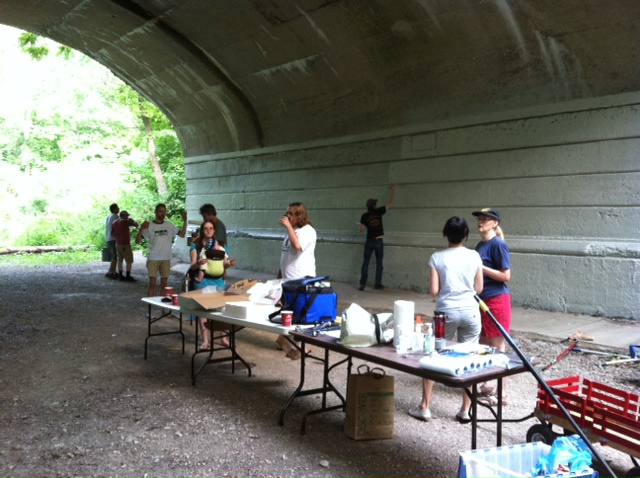
Saturday morning, Pete and I headed down to the underpass in Glen Echo, the one that will turn into the beautiful bird mural. The purpose of our trip was to help prime the bridge for the painting that Clint Davidson, the artist, would hopefully begin today. To be honest, I wasn’t sure what kind of a turnout there would be and got a little worried as we approached, not hearing any voices. Well, I needn’t have worried (the bridge apparently acts like a huge sound absorber!) as once we got closer, there were plenty of people already working. There was food donated from great businesses in Clintonville, including Mozart’s Cafe, Pattycake Bakery, Clintonville Community Market, and Crimson Cup Coffee (thanks, everyone!). Kids in the neighbors had a lemonade stand with all the proceeds going to help pay for the mural. It really made me glad to see so many people coming together to do something so wonderful. We also had a lot of people just walking through the park stop by and ask us what we were doing.

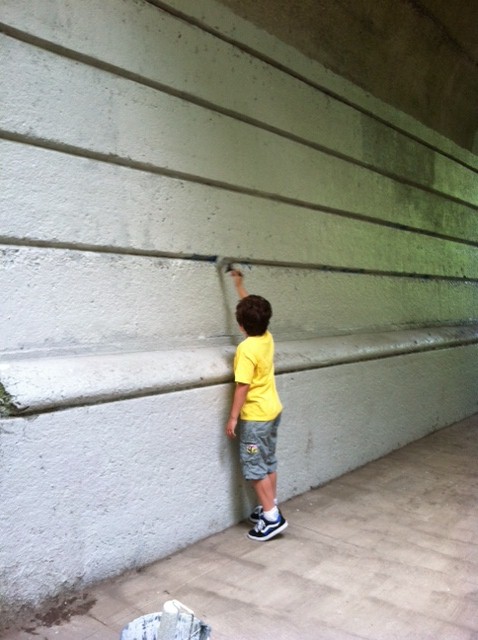
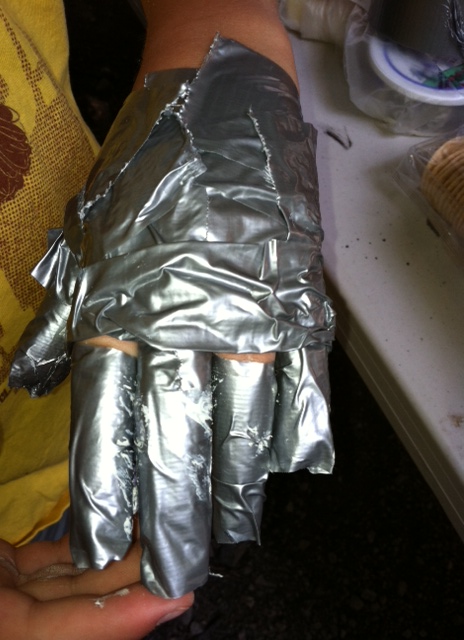
The job went much faster than I ever thought possible. But I must admit, the painting was quite different from any I’ve ever done — and not the sort my very neat and clean painter mom would condone! There were no drop cloths, no painter’s tape, no worries about drips and runs. It all went very well with the exception of a few millipedes who were hiding in the crevices that managed to get some paint on them. Pete, of course, rescued them all. We even had several kids helping out, one who was rather creative in his technique for keeping the paint off of his fingers! The worst part was trying to paint in the parts that were filled with dirt; we just did our best!

In the end, we had a lovely blank canvas for Clint to begin drawing in the sketches of the various resident or migratory birds. I can’t thank you all enough for the help and support you’ve shown to make this mural happen! And I can’t wait to post updates on how the mural is progressing. I know it will be beautiful to see.

Until next time!

Wait – There’s a Good Honeysuckle?!

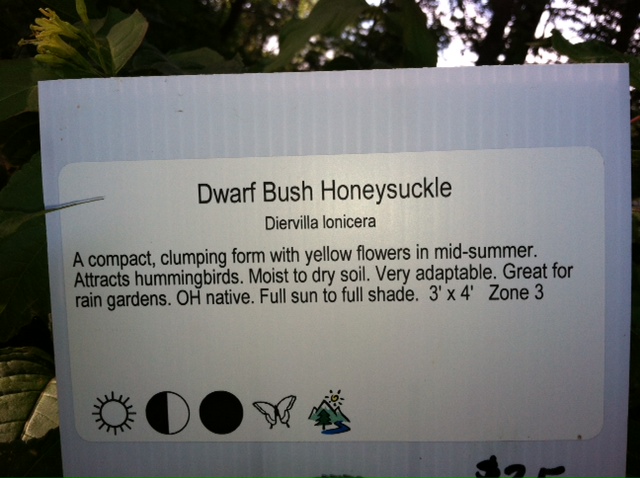
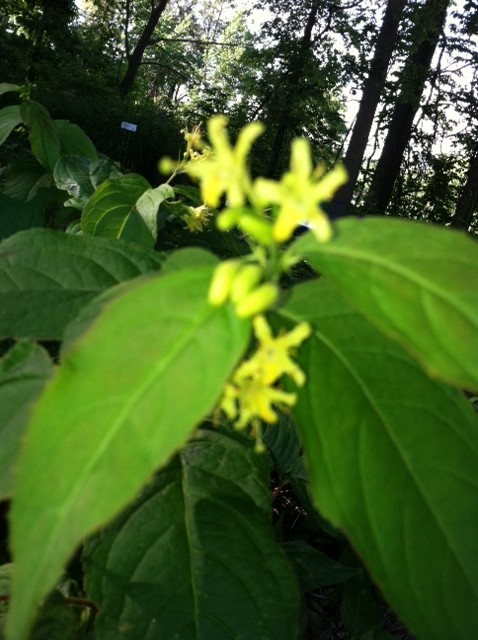
This weekend, Pete and I were at one of our favorite places to buy native plants, Scioto Gardens. I really enjoy talking to the owner, Mike, who is so knowledgeable about all the plants in Ohio. I often fear for ever getting Pete to leave, especially when he and Mike start talking about native orchids. Anyway, we were up at Scioto Gardens looking at plants when I heard Pete exclaim, “Mike! What are you doing selling honeysuckle?!” Then, as Mike started to come over to see what all the fuss was about, I heard Pete yell, “Holy cow! There’s a native honeysuckle? I didn’t know there was a native honeysuckle! It looks just like the stuff we are trying to pull out of the ravine! And it smells good, too! We can replace all the non-native honeysuckle with this native stuff! I have to get some of this for my yard! Wait until I tell Mike (McLaughlin) and Jason (Advani) that I planted honeysuckle in my backyard! They won’t believe it! They know I hate honeysuckle!” (If you’ve ever heard Pete talk about native plants, this conversation is very believable…)

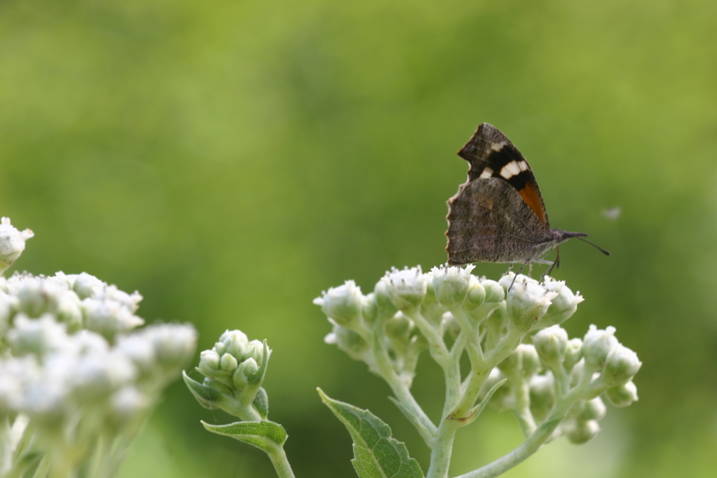
Now Pete is always one to extoll the virtues of using native plants. I agree that natives can be beautiful and can better handle the weather conditions in Ohio, including drought. But one of the other benefits of having native plants is the insects that are attracted to these plants, something that my entomologist husband gets excited about. When I can home from work today, Pete was like a little kid, informing me that we had a snout butterfly (Libytheana carinenta) in our yard, something that John Shuey, who studies butterflies, told Pete would never make its way into an urban environment. My first thought was, “How could anyone put the word “snout” in a name for something as beautiful as a butterfly?” (When you look at the picture, you’ll see why that common name was chosen.) Pete thinks that the combination of removing invasive species from Glen Echo along with the newly planted native trees is bringing a greater diversity to our neighborhood.

According to the Ohio Department of Natural Resources, the American Snout is the only butterfly species that was originally described from Ohio. In other words, the first butterfly of this species ever found was in Ohio, in 1852, by Jared P. Kirkland, a naturalist from Cleveland. The larvae feed on hackberry; this butterfly was feeding on the wild quinine in our yard and seemed quite content to get all of his (or her) nectar from that source.

Until next time.

Bird Mural for Glen Echo Indianola Street Bridge Is A Go!

I was going to make this post a request to send funds to help get this wonderful bird mural painted in the underpass to the Glen Echo Bridge at Indianola. However, in the one day that I waited to make this post (just too hot yesterday!) apparently so many of you donated that the goal of $2800 has been reached! That is so awesome! However, we still need a little bit of help to get the bridge primed.

How you can help ALT:
Join us to prime the walls at the underpass on June 16, 2012 (Saturday) 9 a.m. – noon. Bring yourself, your kids, and friends. primers, tools, and light refreshments will be provided. Meet us at the Indianola Bridge underpass.

You can contact ALT at altcolumbus@gmail.com

Until next time!

Which Tree is That?

I hope everyone had a nice Memorial Day weekend. Pete and I went to visit some relatives and other than seeing my family, the highlight of the trip was going to the MAPS Air Museum near Akron/Canton Airport. We had the honor of going on a guided tour with Ralph, who was a B-24 bomber pilot in WWII, flying missions over Germany. Pete and I so enjoyed his many stories. A belated thanks to all our servicemen and women who have done so much for our country.

With the nicer weather, I’ve been able to walk to work again. As I walk along, with all the new trees in our neighborhood, I am struggling to figure out which tree is which. Now I can spot an oak tree from a mile away as those are my favorites. Maples are pretty easy, as are the shag bark hickories. But ask me which kind of oak a tree is, and I’m pretty much at a loss unless it’s a pin oak. And I only know silver maples because they are everywhere and their leaves look, well, silver. The shag bark hickory is one that I know more by its bark (strangely enough, rather shaggy looking!) than its leaves. But I struggle to identify many of the trees in our neighborhood that are new to me, especially the oaks. So I went on line to look to see if there is some sort of guide to use. I found a great one online at Arbor.org. It’s especially helpful because it walks you through the identification with a series of questions about the tree itself. I think that Pete uses such a thing, called a key, to identify insects. I still need to work on being able to better identify trees by looking at them. And I am thankful for the maps at our kiosk on Weber, too, as they will help me learn about our trees. Has anyone taken one of the walks yet? I’ve gone by once to replace the maps, and they are almost gone again. So if you have used one, please let me know how it went!

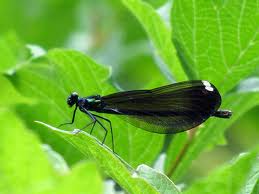
Today, Pete and I went for a walk to Weiland’s for some groceries, and we took the scenic route along Wahalla Ravine. We were commenting on the diversity of plants that were in the ravine (apart from the invasives). It’s nice to see the native plants within the ravine. As we walked along the stream, I saw some insects that turned out to be damsel flies. Pete was pleasantly surprised to see them as they require a somewhat clean water source. (Ironically, there is a sign warning people to stay out of the water as it can contain raw sewage.) For those of you who are interested, damsel flies differ from dragonflies in how they hold their wings. Dragonflies hold their wings horizontal to their bodies while damsel flies hold them vertically above their bodies. (Don’t get me started on how to identify insects: I can tell you about true bugs being the only ones with sucking mouth parts and flies having compound eyes…ah, the joys of living with an entomologist!)

But back to the diversity: Pete has been seeing insects around our yard that he hasn’t seen before and the same hold true with birds. I really believe that the native trees as well as the cleanup in Glen Echo has made a huge difference in how our little part of the planet is working. It’s nice to see.

Until next time!

Don’t Forget to Water Your New Trees!

Now that the weather has heated up (near 90 for part of this week!) and the rain has vanished for a while, I just wanted to remind everyone who received a tree in front of their property that those trees need to be watered once a week, at least through September (unless, of course, we get a gentle rain that puts down about an inch of water, then you can most likely skip watering for that week). What we want the trees to do is send out new feeder roots that will help to establish the tree for the next spring and summer. Right now, the trees need just the right amount of water: enough to keep the tree healthy and thriving, but not so much as to make the tree not feel the need to grow additional roots.

The best way to water your new tree is to give it about five gallons of water at a slow drip. What we’ve done that seems to work well is to fill a large plant pot with water, the kind that has drainage holes in the bottom. This will allow the water to slowly seep into the ground, which will provide optimal watering. Or if you are willing to ruin a bucket, drill a hole  or two in the bottom for the same effect. Or  you can drag a hose out and let it trickle for about 45 minutes.

One way to help you determine if your tree needs water is to stick a pointed dowel rod in the ground; if it comes out clean you need to water, and if you can’t stick it in the ground you really need to water. So if you see a tree that looks stressed (it will look wilted), please either give it a nice long drink yourself or contact us at the Arboretum, and we will see that the tree is taken care of. You can contact Pete at 614/261-0092. If you aren’t sure whether your tree needs watering, just contact us, and we will be happy to come out and take a look. We are walking around, keeping an eye on our trees, but we might miss one, so please let us know if one needs attention.

Thanks for taking care of our new trees (or your neighbor’s)!

Until next time!

A Tale of Two Kitties

After all the happy news about our ribbon cutting, this post won’t be quite so upbeat. It’s a very difficult post to write because I love cats, and I love birds. In nature, cats and birds are enemies, as birds would be considered a food source in the wild. But here in Clintonville, we don’t have any feral cats that I know of, so for cats, birds become something to catch and play with and kill. They have a strong hunting instinct that kicks in even if they aren’t hungry.

We have several cats in our neighborhood who roam outside most of the day. I love cats and know that they will chase and catch anything they can. (Remember this post?) Some of the cats near us have bells on their collars that will warn away birds and other creatures like squirrels. I still remember one of the saddest sights from last year: a momma squirrel crying so forlornly, carrying her dead baby in her mouth. It had been attacked by a cat. I started to cry and just couldn’t stop. This year already, we’ve found several dead birds that had been killed by cats in our neighborhood. I have Pete bury them as I say a few words of love to speed them on their way to wherever they are going.

The best solution is for the cat owners to keep their cats inside, not only for the bird’s protection, but for the cat’s. I’ve come close several times to hitting a cat near our home. But if you are like us and have cats just coming into the yard (which we are trying to make a place that birds like to come and visit), then here are some suggestions on how we all can help our fine-feathered friends:

  • Have the cat wear a bell on its collar.
  • Keep claws trimmed to prevent climbing to get to birds.
  • If cats must go outdoors, do not leave them unsupervised, and do not allow them outside overnight, during early morning or other peak bird feeding times.
  • Keep bird feeders and bird baths at least five feet from shrubbery and cover that can conceal a stalking predator. Ideally, feeders should be 10-12 feet from potentially dangerous cover.
  • Check brush piles and shrubbery regularly for ground nests and fledgling birds that are most vulnerable to prowling cats.
  • Avoid using low feeders or ground feeders that make it easier for cats to capture wild birds. Clean up spilled seed regularly to minimize ground feeding birds.
  • Use plastic or metal poles to support feeders so cats’ claws cannot help them climb to the feeder. Baffles are another option to deter hunting cats.

I will leave you with this very sad photo taken in Glen Echo by Chris O’Leary. It’s an indigo bunting that was killed by a cat without a bell on its collar. I have never seen one of these beautiful birds (Pete has in the ravine), and I can tell you that this is not how I wanted to view this bird for the first time. It saddens me so.

Until next time.