Don’t Forget to Water Your New Trees!

Now that the weather has heated up (near 90 for part of this week!) and the rain has vanished for a while, I just wanted to remind everyone who received a tree in front of their property that those trees need to be watered once a week, at least through September (unless, of course, we get a gentle rain that puts down about an inch of water, then you can most likely skip watering for that week). What we want the trees to do is send out new feeder roots that will help to establish the tree for the next spring and summer. Right now, the trees need just the right amount of water: enough to keep the tree healthy and thriving, but not so much as to make the tree not feel the need to grow additional roots.

The best way to water your new tree is to give it about five gallons of water at a slow drip. What we’ve done that seems to work well is to fill a large plant pot with water, the kind that has drainage holes in the bottom. This will allow the water to slowly seep into the ground, which will provide optimal watering. Or if you are willing to ruin a bucket, drill a hole  or two in the bottom for the same effect. Or  you can drag a hose out and let it trickle for about 45 minutes.

One way to help you determine if your tree needs water is to stick a pointed dowel rod in the ground; if it comes out clean you need to water, and if you can’t stick it in the ground you really need to water. So if you see a tree that looks stressed (it will look wilted), please either give it a nice long drink yourself or contact us at the Arboretum, and we will see that the tree is taken care of. You can contact Pete at 614/261-0092. If you aren’t sure whether your tree needs watering, just contact us, and we will be happy to come out and take a look. We are walking around, keeping an eye on our trees, but we might miss one, so please let us know if one needs attention.

Thanks for taking care of our new trees (or your neighbor’s)!

Until next time!

A Tale of Two Kitties

After all the happy news about our ribbon cutting, this post won’t be quite so upbeat. It’s a very difficult post to write because I love cats, and I love birds. In nature, cats and birds are enemies, as birds would be considered a food source in the wild. But here in Clintonville, we don’t have any feral cats that I know of, so for cats, birds become something to catch and play with and kill. They have a strong hunting instinct that kicks in even if they aren’t hungry.

We have several cats in our neighborhood who roam outside most of the day. I love cats and know that they will chase and catch anything they can. (Remember this post?) Some of the cats near us have bells on their collars that will warn away birds and other creatures like squirrels. I still remember one of the saddest sights from last year: a momma squirrel crying so forlornly, carrying her dead baby in her mouth. It had been attacked by a cat. I started to cry and just couldn’t stop. This year already, we’ve found several dead birds that had been killed by cats in our neighborhood. I have Pete bury them as I say a few words of love to speed them on their way to wherever they are going.

The best solution is for the cat owners to keep their cats inside, not only for the bird’s protection, but for the cat’s. I’ve come close several times to hitting a cat near our home. But if you are like us and have cats just coming into the yard (which we are trying to make a place that birds like to come and visit), then here are some suggestions on how we all can help our fine-feathered friends:

  • Have the cat wear a bell on its collar.
  • Keep claws trimmed to prevent climbing to get to birds.
  • If cats must go outdoors, do not leave them unsupervised, and do not allow them outside overnight, during early morning or other peak bird feeding times.
  • Keep bird feeders and bird baths at least five feet from shrubbery and cover that can conceal a stalking predator. Ideally, feeders should be 10-12 feet from potentially dangerous cover.
  • Check brush piles and shrubbery regularly for ground nests and fledgling birds that are most vulnerable to prowling cats.
  • Avoid using low feeders or ground feeders that make it easier for cats to capture wild birds. Clean up spilled seed regularly to minimize ground feeding birds.
  • Use plastic or metal poles to support feeders so cats’ claws cannot help them climb to the feeder. Baffles are another option to deter hunting cats.

I will leave you with this very sad photo taken in Glen Echo by Chris O’Leary. It’s an indigo bunting that was killed by a cat without a bell on its collar. I have never seen one of these beautiful birds (Pete has in the ravine), and I can tell you that this is not how I wanted to view this bird for the first time. It saddens me so.

Until next time.

Arboretum Tree Walks

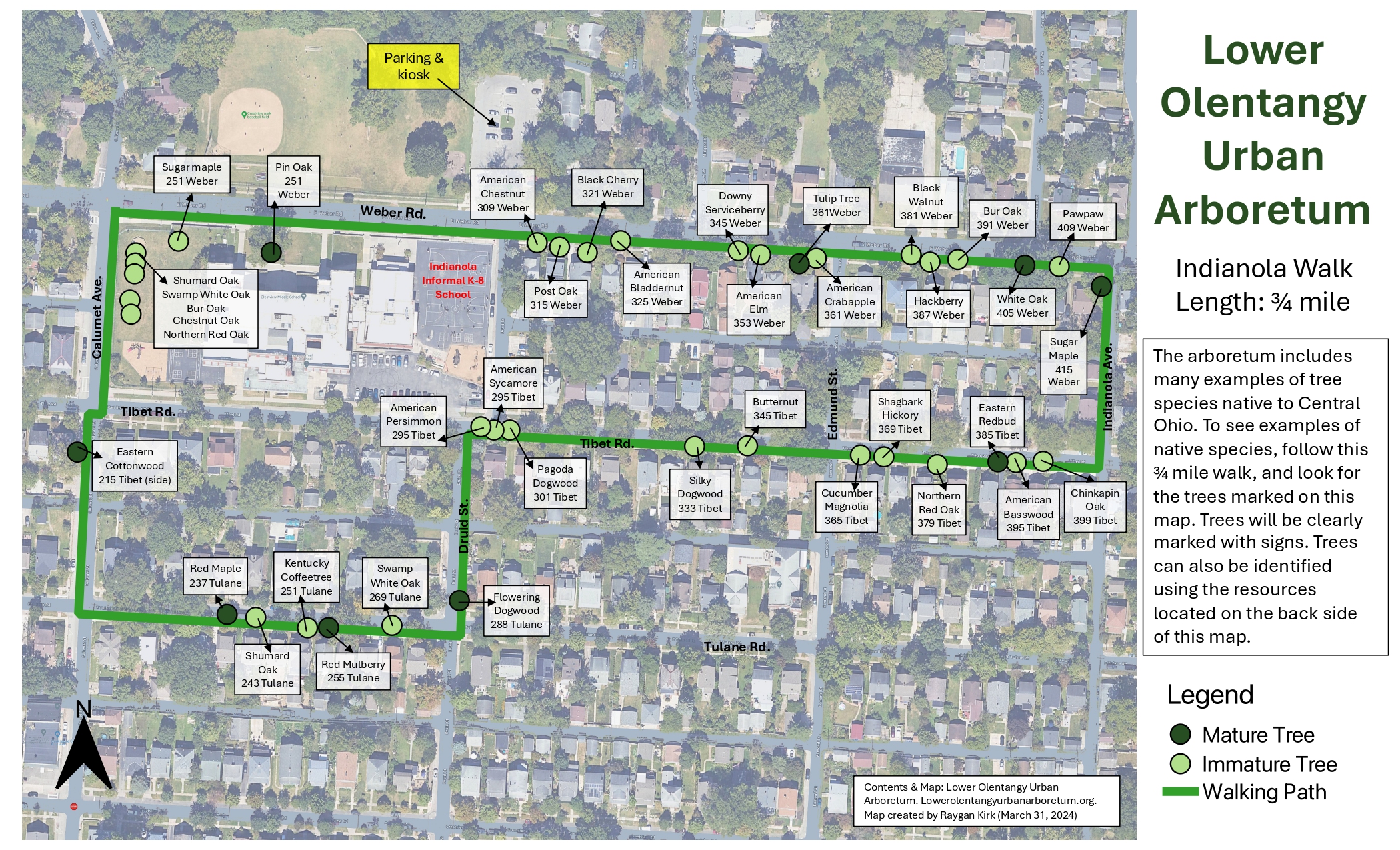
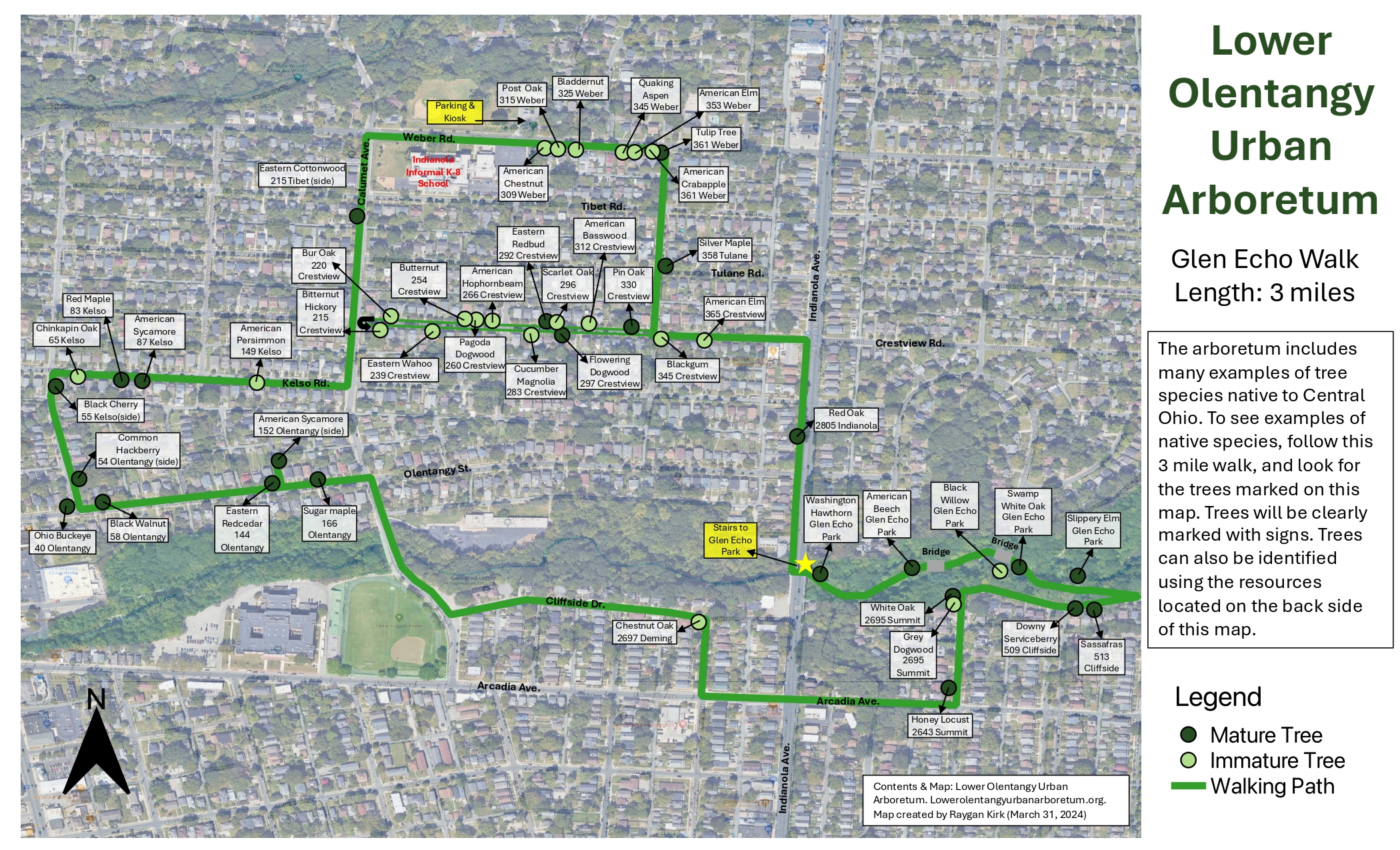
As I mentioned in my last post, there are now maps for the two walks on the Arboretum: the Indianola (a shorter walk) and the Glen Echo (a longer walk). These maps can be found in the brochure boxes on the kiosk. Since the tree markers that we ordered haven’t come in yet, I wanted to let you know what to look for to identify each tree on the walks:

These are the temporary markers that are in front of the tree that is described in the tree walk. The number on the tag matches the number on the map. The real markers that we are waiting on will contain a lot more information about the tree itself: common name, scientific name, etc.

So until those come in, we will be using these little lovelies, all hand-created by me! They aren’t too hard to miss at about 10 inches. You can see below about how tall they are.

When you take either of these walks, please send me a comment. We want the walks to be enjoyable, and should there be anything that we can do to make them better, we’d appreciate any suggestions!

Until next time!

It’s Official – We’re an Arboretum with a Kiosk!

Our Arboretum kiosk ribbon cutting ceremony was an unqualified success! I will admit that I had my usual pre-party jitters, the ones that makes you think no-one is going to show up at all to your gathering. But that wasn’t the case today. There must have been over 40 people in the parking lot, all waiting to hear about our Arboretum.

Mike McLaughlin, Pete Kovarik, Dan Struve, Martha Buckalou, Cindy Gunn, Laura Fay, and Chris O’Leary all spoke, each representing a partner of LOUA. Then the actual ribbon cutting took place. I managed to take a video of the ribbon cutting on my iPhone, and this one wasn’t upside down. That’s Chad Hoff, nursery director (left) and Alan McKnight, director of Columbus Recreation and Parks, both from the City of Columbus, who have given us so much support, cutting the ribbon.

With the large turnout, there were many people who signed up for an annual membership with LOUA. They all proudly walked away with a new t-shirt bearing our logo. Then Pete took a group of us on the Indianola Walk, which took a little over an hour. It was much longer than usual because Pete stopped at each tree and gave a little talk about what kind of tree we were looking at, what benefit it had to wildlife, and other interesting facts. If you want to take either of the walks, the Indianola (shorter) or the Glen Echo (longer), there are maps in the kiosk along with membership forms. We have several levels for donating; every little bit helps out! And you can also donate at on this blog by clicking on the “How To Help” tab at the top of the page.

The best part of the day was as we finished the walk and were heading back into the parking lot, we saw someone walking away from our kiosk, map in hand. It was an amazing feeling. We have accomplished so much and had so many helping hands along the way.

Until next time.

Ribbon Cutting This Saturday

Just a reminder that we are having our ribbon cutting for the Arboretum kiosk on:

Saturday, May 12, 2012
11am
Parking lot across from Indianola Informal k-8
251 East Weber Road
(Between Calumet and Druid)

ThisWeek/The Booster has a lovely article about the ribbon cutting and the Arboretum. I must admit, my quote about cats and kittens sounded way better in my head. If you are wondering what I am talking about, just read it and see! But it’s a great article by Kevin Parks at ThisWeek Community News. He’s been covering the Arboretum from the beginning and has given us such good press. Thanks, Kevin!

And as an added bonus, we will have LOUA t-shirts at the ribbon cutting. And just what do you need to do to get one of these t-shirts? Anyone who becomes an Arboretum member at the $45 level gets a t-shirt with their paid annual membership. And these t-shirts are very nice so you will be the envy of all your friends! And a huge shout out and thank you to McKenzie Wilhelm who designed our new logo. She on the Arboretum and a student at Ohio State.

Finally, after you come to the ribbon cutting, become a member, and take the tree walk, you need to proudly wear your new t-shirt to the annual Chadwick Arboretum plant sale. Click here for more information. Among the many booths selling plants will be Arboretum members Dan Struve and Meghan Blake (who work at Ohio State’s Department of Horticulture and Crop Science). Pete and I have gone for the past five or six years and have always found some nice native plants to bring home.

Until Saturday! We hope to see you then!

Summertime, and the Living is Easy

Well, it’s not exactly summertime, although it certainly feels like it! We have the windows open, and all the cats are fighting over who shall sit where. Windows in the bedroom are prime at night. With four cats and three windows, well, you do the math. There’s always one cat who is unhappy!

This warmer weather combined with all the rain makes me think of mosquitoes. I haven’t seen any of the Asian tigers just yet; those are the ones with the lovely black and white striped legs that don’t mind that it’s not dark outside. They will find you and bite you in the daylight. So unfair! As a kid, I would always spend time at my grandma’s in the summer. Her house was old, and the window screens had small holes in them. No matter how they were patched, the holes would come back. So at night, I would inevitably hear that ever so annoying whining in my ear as a mosquito flew around, looking for a place to land and have a feast. The worst part was when the buzzing stopped; that meant the creature had landed somewhere on me. I’d get up and try and find the insect. Never could see the dang thing, and I’d end up with bites every morning.

So with all the rain we’ve been having, I thought it would be good to go over a few tips on how to keep mosquitoes from breeding in your yard. All mosquitoes need water at some point in their life cycle. Some will search out water to lay eggs in while others will lay eggs in areas that will eventually get filled with water, then the eggs will hatch. To cut down on breeding areas:

  • Empty, drain, remove, cover or turn upside down things that can hold water.
  • Empty any small plastic wading pools weekly. Store it indoors when not in use.
  • Repair leaky pipes and outside faucets.
  • Don’t let runoff water from your air conditioner collect in shady areas.
  • Clean debris from rain gutters and unclog obstructed downspouts.
  • Scrub and change the water in bird baths weekly.
  • Empty and refill outdoor pets’ water pans daily.

Remember: mosquitoes only need a small amount of water in which to breed or to hatch their eggs. Remove the water, and you remove the potential biters.  Although there are natural predators out there that will eat mosquitoes (bats, birds, dragonflies and the like), they are not the best way to reduce the population. The best way is to not allow the mosquitoes to breed in the first place.

And a reminder that our kiosk ribbon cutting is on:
Saturday, May 12, 2012
11am
Parking lot across from Indianola Informal K-8
251 East Weber Road
(Between Calumet and Druid)
Tree walk to follow!

Until next time!

You Are Invited…

to a Ribbon Cutting! My last post showed you a picture of signs directing people to our lovely arboretum. I imagine that many of you were wondering where exactly the signs were directing visitors to go. Well, LOUA now has a beautiful kiosk across the street from the Indianola Informal K-8 elementary school on Weber. It is the most amazing creation, and many thanks to Jason for coming up with the design and implementing it. Also thanks to Corinne, who chiseled as good as anything Michelangelo ever did. And thanks to Pete, who learned some useful roofing skills in putting on the shingles. Our deepest thanks go to The Columbus Foundation, United Way of Central Ohio, PNC, Bob Evans, and the Osteopathic Heritage Foundation, proud supporters of the 2012 Neighborhood Partnership Grants Program, which provided the funding for the kiosk.

The kiosk will contain information about LOUA, native plants, invasive plants, and other bits along with walking maps. (And membership information!!)

I’ve included a picture of the kiosk nearly finished, which I’ve done on purpose because I want all of you to come out to the parking lot across from the school on Saturday, May 12, 2012 at 11am. We are going to have a ribbon cutting for the kiosk, and then everyone is heading out on the short tree walk. You might recall that we have two walks (a long and short) with maps and information about the trees that one can see along the way. And, of course, you can see the finished kiosk in all of its glory. And meet many of the people who have been involved with LOUA for the past year and beyond. And see some wonderful trees.

When this little dream started, I knew we could make it a reality. But never in my wildest dreams did I imagine it would happen so quickly and on such a great scale. So many people stepped up to help along the way. Each stumbling block we came to, there was always someone who had an answer, someone who could help. We couldn’t have made it this far without everyone’s assistance. If you’d like to help out, please come on Saturday.

Saturday, May 12, 2012
11am
Parking lot across from Indianola Informal K-8
251 East Weber Road
(Between Calumet and Druid)

Until next time!